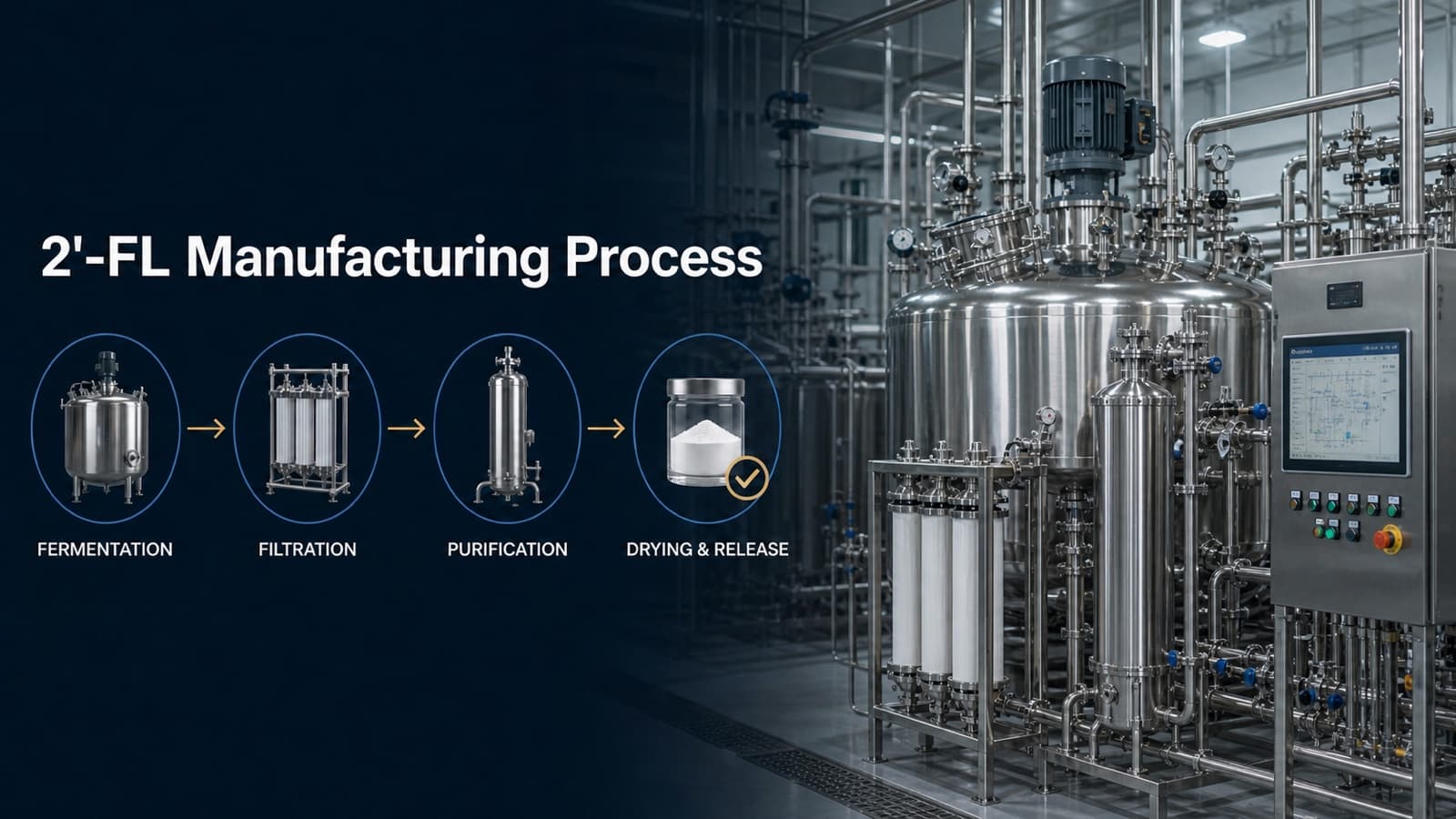
We manufacture fermentation-derived 2'-Fucosyllactose (2'-FL) by producing the target carbohydrate in a controlled fermentation, removing the production culture, purifying the liquid in two stages, and drying it into powder. We then sample, pack, test, and release each batch against the finished-product specification.
Commercial 2'-FL does not come from extracted human milk. The process starts with a production culture and lactose-based feed. Fermentation creates 2'-FL in a liquid broth, while the downstream steps remove cells, proteins, color, salts, water, and related carbohydrates.
The exact sequence matters because fermentation alone does not make a finished food ingredient. The purification and release stages determine whether the powder meets the target assay (measured 2'-FL content), limits for other sugars and oligosaccharides, residual protein and endotoxin limits, microbiological limits, and the required physical condition.
This guide follows our actual 2'-FL production flow. It does not describe a generic HMO process, and the other five HMOs may use different fermentation and purification conditions.
Four Phases, Twelve Steps
Actual 2'-FL Manufacturing Flow
Our flow begins with culture preparation and ends with finished-product release. The four phases below keep the sequence readable without removing the individual production and control steps.
Fermentation Preparation
- 01Culture Media Preparation
Prepare the controlled nutrient medium used for culture growth and production.
- 02Strain Cultivation
Cultivate the production strain under defined conditions.
- 03Seed Preparation
Build a healthy starter culture for the main fermenter.
Fermentation and Cell Removal
- 04Fermentation
Run the controlled production stage that converts lactose-based feed into 2'-FL.
- 05Inactivation and Microfiltration
Inactivate the culture and remove cells and suspended material with microfiltration.
Two-Stage Purification
- 06Ultrafiltration, Decolorization, and Desalination
Reduce larger molecules, color, salts, and other fermentation materials. This is CCP1.
- 07First Concentration
Remove water before the second purification stage.
- 08Chromatographic Separation
Separate 2'-FL from related carbohydrates and remaining process materials. This is CCP2.
- 09Second Concentration
Prepare the purified liquid for powder production.
Powder Finishing and Release
- 10Drying
Convert the concentrated 2'-FL liquid into a stable powder.
- 11Sampling, Metal Detection, and Packaging
Sample the batch, run metal detection, and pack it in a Class 100,000 cleanroom.
- 12Quality Control and Release
Compare the batch results with the finished-product specification before release.
The production flow chart places the two Critical Control Points in the purification phase. Sampling, metal detection, and packaging take place in the cleanroom portion of the flow before final quality review.
Product Formation
What Fermentation Does
Fermentation provides the controlled environment in which the production culture makes 2'-FL. The culture uses a nutrient medium and lactose-based feed, while the process controls conditions such as time, temperature, pH, nutrient supply, and aeration within the validated operating range.
Culture Media, Strain, and Seed Preparation
The first three steps prepare a consistent production culture. We prepare the culture medium, cultivate the strain, and expand a seed culture before transferring it to the main fermenter. Seed preparation gives the production vessel an active, controlled starting culture instead of asking a small laboratory culture to begin a large batch directly.
Our production platform uses an inorganic-salt culture medium. A simpler medium reduces complex organic carryover and odor before downstream purification. It also supports high-cell-density cultivation, which means growing more production cells in a controlled volume, without relying on a complex laboratory growth medium.
Main Fermentation
During the main fermentation, the production culture assembles the fucosylated trisaccharide 2'-FL. A trisaccharide contains three simple sugar units. For 2'-FL, those units are fucose, galactose, and glucose, with fucose connected to the galactose part of lactose through an alpha-1,2 linkage.
The batch leaving the fermenter is a liquid mixture, not finished 2'-FL powder. It contains the target HMO together with the production culture, water, salts, proteins, unused carbohydrates, color, and related carbohydrates. Downstream processing must separate these materials without changing the identity of 2'-FL.
Downstream Processing
Why 2'-FL Needs Two Purification Stages
No single filter can remove every unwanted component from fermentation broth. Cell material, proteins, dissolved salts, color compounds, lactose, difucosyllactose, and 2'-FL differ in size and chemical behavior. Our process therefore uses several separation methods in a defined order.
Inactivation and Microfiltration Remove the Production Culture
We first inactivate the culture and use microfiltration to separate cells and suspended material from the 2'-FL-containing liquid. Microfiltration uses a membrane with controlled pore size. The liquid and dissolved carbohydrates pass through, while the membrane retains larger particles and cell material.
Purification 1 Reduces Larger Molecules, Color, and Salts
The first purification stage combines ultrafiltration with decolorization and desalination. Ultrafiltration retains larger molecules that passed the earlier separation. Decolorization reduces color-bearing material, while desalination removes dissolved mineral salts. Our production flow identifies this stage as CCP1.
Chromatography Separates Closely Related Carbohydrates
After the first concentration step, chromatographic separation resolves 2'-FL from related carbohydrates that a simple particle filter cannot distinguish. Chromatography separates dissolved compounds by how they interact with the separation medium. This stage directly supports the target 2'-FL assay and the limits for D-lactose and difucosyllactose. Our flow identifies it as CCP2.
Water-Phase Purification Avoids an Organic-Solvent Step
We use water as the process medium during purification and combine controlled conditions with filtration and chromatography. This water-phase purification approach does not introduce an organic solvent during the described purification stages. It simplifies solvent-residue control and supports a neutral powder without a solvent-derived odor.
Concentration and Drying Create the Powder
The two concentration steps remove water at different points in the process. The first prepares the liquid for chromatographic separation. The second prepares the purified 2'-FL solution for drying. Drying then converts the concentrated liquid into a white to off-white powder with a defined water limit.
Process Control
Critical Control Points and Batch Release
CCP means Critical Control Point. A Hazard Analysis and Critical Control Point (HACCP) food-safety plan uses a CCP when the manufacturer must control a defined hazard at that stage. Our 2'-FL flow marks the first purification stage as CCP1 and chromatographic separation as CCP2. The production team monitors the validated operating limits and records the result for each batch.
After drying, we sample the powder, run metal detection, and pack it in the area that our flow chart designates as a Class 100,000 cleanroom. Quality control reviews the batch record and release results before the material becomes finished product.
How Each Process Step Connects to the Specification
| Production Stage | What the Stage Controls | Related Batch Evidence |
|---|---|---|
| Inactivation and microfiltration | Removes the production culture and suspended fermentation material | Residual viable-cell and exogenous-DNA testing |
| Purification 1 - CCP1 | Reduces larger molecules, color bodies, and dissolved salts | Residual protein, ash, color, and solution checks |
| Chromatographic separation - CCP2 | Separates the target 2'-FL from closely related carbohydrates | 2'-FL assay, D-lactose, and difucosyllactose results |
| Concentration and drying | Removes water and creates the finished powder form | Water result and powder appearance |
| Cleanroom packaging | Protects the powder during sampling and final packing | Metal-detector check, package inspection, and retained sample |
| Quality control and release | Confirms that the batch meets the current product specification | Complete batch record and release test results |
Current 2'-FL Release Snapshot
The process must produce a batch that meets the current specification. These selected limits show how the release tests connect to purity, residual control, and microbiological quality:
- 2'-FL: at least 94.0% on a water-free basis
- D-Lactose: no more than 3.0%; difucosyllactose: no more than 2.0%
- Water: no more than 5.0%; ash: no more than 0.5%
- Residual protein: no more than 100 mg/kg; endotoxins: no more than 10 EU/mg
- Total plate count: no more than 500 CFU/g; Enterobacteriaceae: less than 10 CFU/g
- Salmonella: absent in 25 g
We also maintain batch-testing capability for residual exogenous DNA, residual viable bacteria, residual protein, and endotoxins. Nutrition companies can discuss additional project-specific limits before sample or commercial review.
Source-Specific Evidence
What Official Safety Reviews Examine
Official safety reviews apply to the exact 2'-FL material described in each dossier, not every product with the same short name. Reviewers examine the production organism, genetic characterization, raw materials, manufacturing flow, removal of the production culture, composition, batch consistency, residual controls, specifications, stability, intake, and intended uses.
In an assessment for one defined fermentation-derived 2'-FL material, the EFSA 2'-FL safety assessment (doi: 10.2903/j.efsa.2022.7647), the manufacturing description covered fermentation, culture inactivation, microfiltration, further filtration, concentration, and drying. The dossier also addressed the absence of viable production cells and detectable residual production-strain DNA.
The FDA GRN 650 record provides the public notice and FDA response for a separate 2'-FL material. The Commission Implementing Regulation (EU) 2023/859 authorizes 2'-FL made with the production organism and conditions named in that regulation.
These official records explain what regulators examine. A record for one 2'-FL source cannot automatically be applied to another source. Match the exact commercial material with the current record for your market before launch.
We checked these official references on July 14, 2026. Regulations, data-protection periods, and inventory pages can change, so open the current record during the final market review.
Project Qualification
What Nutrition Companies Should Review
A useful manufacturing review connects the commercial source, process controls, specification, and finished-product plan. Use these questions before approving a sample or moving into formulation trials:
- Does the exact commercial 2'-FL source fit your market and finished-product category?
- Does the manufacturing package include a current flow chart and a clear HACCP or food-safety control summary?
- Does the specification state whether the 2'-FL assay uses an as-is or water-free calculation?
- Which related carbohydrates, residual proteins, viable cells, residual DNA, and endotoxins does the batch-control plan cover?
- Do representative batch results support the purity and microbiological limits required for the project?
- Have pilot batches confirmed solubility and stability under the finished product's real heat, pH, moisture, and storage conditions?
- Do the packaging format, storage condition, shelf life, and transport plan match the production schedule?
Our Process
Our 2'-FL Manufacturing Advantages
We manufacture fermentation-derived 2'-FL through a documented process designed for consistent purification and batch release. The practical advantages come from how the stages work together:
- Controlled fermentation: culture preparation, seed expansion, and main fermentation follow one defined production sequence.
- Inorganic-salt culture medium: the medium supports production while limiting complex organic carryover before purification.
- Water-phase purification: filtration and chromatography purify the liquid without introducing an organic-solvent purification step.
- Two purification stages and two CCPs: membrane operations and chromatography address different impurity groups.
- Batch-level residue control: our testing capability covers residual DNA, viable bacteria, proteins, and endotoxins.
Review the 2'-FL product page and current specification, compare it with our 2'-FL and 3-FL guide, or contact us about a 2'-FL formulation project.