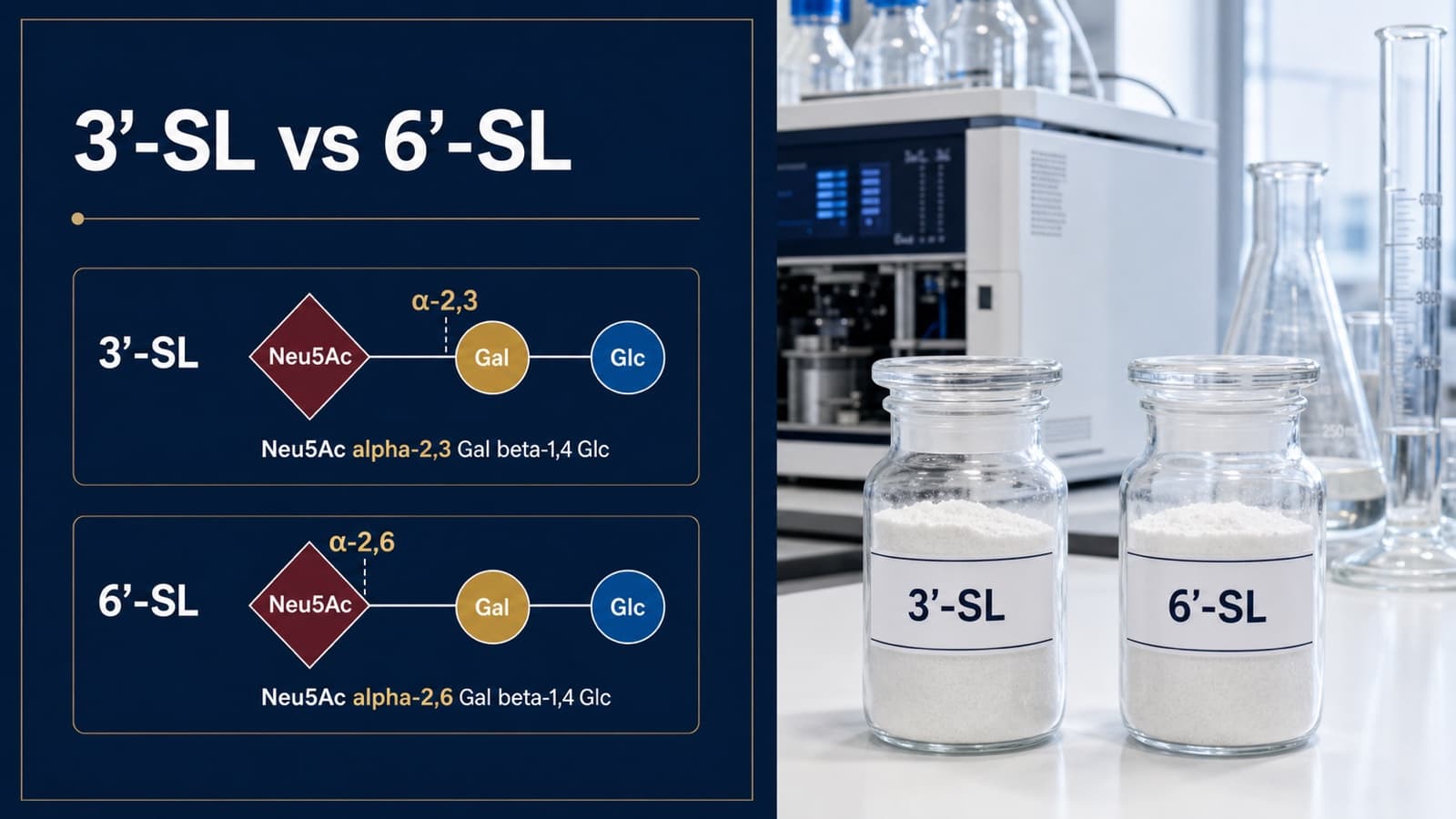
3'-Sialyllactose sodium salt (3'-SL) and 6'-Sialyllactose sodium salt (6'-SL) are separate sialylated HMO ingredients. The number in each name tells you where sialic acid attaches to galactose: carbon 3 in 3'-SL and carbon 6 in 6'-SL. A nutrition formula may use either HMO or both, depending on the intended application and the evidence for that exact structure.
3'-SL and 6'-SL share several basic chemical features. Each contains lactose plus one N-acetylneuraminic acid unit, usually called Neu5Ac or sialic acid, and both have the molecular formula C23H38NO19Na and the relative molecular mass 655.53.
In 3'-SL, sialic acid attaches to carbon 3 of galactose through an alpha-2,3 linkage, while 6'-SL uses an alpha-2,6 linkage at carbon 6. This difference gives them separate CAS numbers, related-carbohydrate profiles, study results, and market authorizations. Their shared formula and molecular mass do not make them interchangeable.
Base the choice on the finished product and the evidence you plan to use. Evaluate 3'-SL when the research or formula specifies the alpha-2,3 structure, and choose 6'-SL for alpha-2,6. A blend needs a clear reason to include both. Assay percentages and maximum use levels do not tell you which structure suits the product.
Key Differences between 3'-SL and 6'-SL
| Point of Comparison | 3'-SL | 6'-SL |
|---|---|---|
| Full Name | 3'-Sialyllactose sodium salt | 6'-Sialyllactose sodium salt |
| Sialic Acid Connection | Neu5Ac alpha-2,3 to galactose | Neu5Ac alpha-2,6 to galactose |
| Condensed Structure | Neu5Ac alpha-2,3 Gal beta-1,4 Glc | Neu5Ac alpha-2,6 Gal beta-1,4 Glc |
| CAS Number | CAS 128596-80-5 | CAS 157574-76-0 |
| Molecular Formula | C23H38NO19Na | C23H38NO19Na |
| Relative Molecular Mass | 655.53 | 655.53 |
| Our Current Target Assay | At least 88.0% on a water-free basis | At least 90.0% |
The identity and assay values above describe our current 3'-SL and 6'-SL products. Other commercial sources may use different specifications.
Molecular Identity
The Difference Is Where Sialic Acid Connects
A glycosidic linkage is the bond that joins one sugar unit to another. Both molecules contain lactose, in which galactose connects to glucose through a beta-1,4 linkage. Sialic acid then attaches to a different position on the galactose.
3'-SL
Neu5Ac connects to carbon 3 of the galactose unit.
6'-SL
Neu5Ac connects to carbon 6 of the galactose unit.
Official records identify 3'-SL and 6'-SL by separate structures and CAS numbers. A molecular formula or molecular-mass result cannot tell your laboratory which one is present.
Your laboratory needs an identity method that separates 3'-SL from 6'-SL and from their sialyllactulose forms. A total-carbohydrate test cannot make that distinction.
Product Quality
How to Compare Our 3'-SL and 6'-SL Specifications
Compare 3'-SL and 6'-SL as two different ingredients, not as two purity grades of the same product. Check which HMO the assay measures and whether the result uses a water-free or another calculation basis. Then review lactose, free Neu5Ac, related carbohydrates, moisture, sodium, process residues, contaminants, and microbiological limits.
Our current specifications set an assay of at least 88.0% for 3'-SL on a water-free basis and at least 90.0% for 6'-SL. Because the two assays quantify different HMO ingredients, use each value as a release limit for the HMO named in that specification.
| Specification Item | 3'-SL | 6'-SL |
|---|---|---|
| Target HMO | 3'-SL sodium salt, water-free: >=88.0% | 6'-SL: >=90.0% |
| D-Lactose | <=3.0% | <=0.5% |
| N-Acetylneuraminic Acid | <=1.5% | <=2.0% |
| Product-Specific Related Carbohydrates | 3'-Sialyllactulose <=5.0% | 6'-Sialyllactulose plus 3'-SL sodium salt <=5.0% |
| Moisture | <=10.5% | <=10.5% |
| Residual Protein | <=100 mg/kg | <=100 mg/kg |
| Endotoxins | <=10 EU/mg | <=10 EU/mg |
| Total Plate Count | <=500 CFU/g | <=500 CFU/g |
| Enterobacteriaceae | <10 CFU/g | <10 CFU/g |
| Salmonella | Absent in 25 g | Absent in 25 g |
Free Neu5Ac means sialic acid that is not attached to lactose. Sialyllactulose is a related carbohydrate, not the target HMO. These limits help your laboratory measure the named HMO separately from similar compounds in the powder.
Our 6'-SL specification has the lower lactose limit: no more than 0.5%, compared with no more than 3.0% for 3'-SL. This can help when your finished product must meet a tight lactose target. Choose the HMO named in the product brief or supporting study, then use the lactose limit to check whether the specification fits the formula.
Both products are sodium salts, so include their sodium contribution when calculating the finished formula. Check the unit on the current specification and batch COA before comparing values. An mg/kg result cannot be compared directly with a value reported in another unit.
Our 6'-SL specification also lists limits for Cronobacter sakazakii, Listeria monocytogenes, and yeast and mould. A longer release-test list does not make 6'-SL the higher-quality ingredient. Set the required tests from the finished product, consumer group, and rules in your market.
Finished-Product Development
3'-SL and 6'-SL Uses in Nutrition Products
Nutrition companies develop early-life products, multi-HMO blends, synbiotic formulas, adult supplements, foods, and drinks with 3'-SL, 6'-SL, or both. Before setting an amount, check whether your market permits the exact source and product category. A market authorization does not support a health claim; a finished-product claim needs evidence for the same HMO and use.
Infant Formula and Young-Child Nutrition
Both HMOs appear in official records for infant formula and young-child nutrition. Before formulating, check the exact ingredient source, consumer age, product category, and proposed amount against the rules in your market.
Single-HMO and Multi-HMO Formulas
A formula may contain 3'-SL, 6'-SL, or both. If you combine them, set a target amount for each HMO and measure each one separately in the finished product.
Synbiotic Products
The same probiotic strain may respond differently to the two linkages. Screen 3'-SL and 6'-SL separately with the actual strain, concentration, and product formula.
Adult Supplements, Foods, and Drinks
Official records list selected supplements, dairy products, fermented foods, drinks, bars, meal replacements, and specialized nutrition. The permitted category and maximum amount depend on the exact ingredient source and market.
Use 3'-SL for an Alpha-2,3 Formula
Consider 3'-SL when the product brief, supporting study, or blend formula specifically uses an alpha-2,3-linked HMO. Next, verify that your market allows the exact 3'-SL source and proposed amount. Our current specification limits free Neu5Ac to 1.5% and sets a separate maximum for 3'-sialyllactulose.
Use 6'-SL for an Alpha-2,6 Formula
Select 6'-SL when the formula or supporting study calls for the alpha-2,6 structure. Its lower lactose limit can also help a finished product meet a stricter requirement. Check whether your market allows the exact 6'-SL source, category, and amount. Your analytical method should separate 6'-SL from 3'-SL and 6'-sialyllactulose.
Use Both When the Formula Needs Both Linkages
Combine them only when the formula deliberately needs the alpha-2,3 and alpha-2,6 structures, rather than adding a second HMO only to make the ingredient list longer. Set an amount for each HMO, calculate both into the batch, and measure both after processing and during shelf life. Check the source, amount, age group, and label conditions for each ingredient in your market.
Research Interpretation
What Cell Studies Show about 3'-SL and 6'-SL
Microbial enzymes and surface proteins can recognize one sugar linkage more readily than another. That is why 3'-SL and 6'-SL can produce different results even when a study uses the same microorganism.
In one Bifidobacterium longum subsp. infantis ATCC 15697 experiment, exposure to 6'-SL raised bacterial adhesion to HT-29 intestinal cells 4.7-fold, whereas 3'-SL alone had no such effect in that cell line. With both HMOs together, adhesion rose 9.8-fold.
The result changed when the researchers used Caco-2 cells. In that model, 3'-SL produced the largest increase; the mixture ranked second, followed by 6'-SL. This does not tell us which HMO works better in people. The HMO, probiotic strain, concentration, and laboratory model all affected the result.
A 2026 comparative absorption and metabolism study found greater uptake of 3'-SL in Caco-2 cells, while 6'-SL broke down more slowly during in vitro fermentation. The animal experiment also found different distribution patterns. These results can help an R&D team choose its next tests, but they do not set a consumer amount or prove a health benefit in a finished product.
Keep Each Result with the HMO That Was Tested
A 3'-SL result does not describe 6'-SL, and a 6'-SL result cannot support statements about 3'-SL. Record the ingredient source, amount, test model, and measured result before applying a study to a product.
Test the Actual Formula
Run a trial with the selected HMO in your powder, drink, fermented product, or synbiotic formula. Protein, minerals, pH, heat, moisture, live cultures, and storage can change the result.
United States
FDA Notices List Different Maximum Use Levels
For a U.S. product, do not copy one use level into every formula. Each GRAS notice applies to a defined ingredient source, specification, food category, and maximum use level.
FDA GRN 1299
GRN 1299 covers one fermentation-derived 3'-SL sodium salt and its listed uses. FDA issued a no-questions response on May 13, 2026.
FDA GRN 1275
GRN 1275 covers one fermentation-derived 6'-SL sodium salt and its listed uses. FDA issued a no-questions response on March 20, 2026.
| Food Category | 3'-SL, GRN 1299 | 6'-SL, GRN 1275 |
|---|---|---|
| Non-exempt formula for term infants | 0.28 g/L | 0.40 g/L |
| Formula-type drinks for young children | 0.28 g/L | 0.50 g/L |
| Sports, isotonic, and energy drinks | 0.45 g/L | 0.50 g/L |
| Unflavoured milk | 0.25 g/L | 0.50 g/L |
| Yogurt | 2.5 g/kg | 5.0 g/kg |
| Other foods for infants and young children | 1.25 g/kg | 2.5 g/kg |
These are maximum use levels from two separate notices, not recommended formula amounts. A higher number for 6'-SL in one category does not show that 6'-SL is more effective than 3'-SL. The difference comes from the source, proposed uses, exposure estimate, and safety information submitted in each notice.
The FDA letters also state that a GRAS response does not replace the section 412 submission required before marketing a new infant formula under the Federal Food, Drug, and Cosmetic Act. The company must notify FDA about the new formula before launch.
European Union
EU Levels Also Depend on the Exact Ingredient Source
An EU authorization can apply to a specific production strain, product specification, food category, maximum level, consumer age, label statement, and data-protection period. Check the production source as well as the HMO name before using an EU maximum level.
Regulation (EU) 2024/1047
Regulation (EU) 2024/1047 covers one defined 3'-SL sodium salt source. It lists the permitted categories, maximum levels, label conditions, and protected data for that source.
Regulation (EU) 2023/2215
Regulation (EU) 2023/2215 covers one defined 6'-SL sodium salt source under its own categories, maximum levels, label conditions, and data-protection period.
| Food Category | 3'-SL, EU 2024/1047 | 6'-SL, EU 2023/2215 |
|---|---|---|
| Unflavoured milk products | 0.25 g/L | 0.50 g/L |
| Flavoured drinks with pH 5 or above | 0.25 g/L | 0.50 g/L |
| Cereal bars | 2.5 g/kg | 5.0 g/kg |
| Infant formula, ready for use | 0.20 g/L | 0.40 g/L |
| Follow-on formula, ready for use | 0.15 g/L | 0.30 g/L |
| Food supplements, excluding infants and young children | 1.0 g/day | 1.0 g/day |
In the two authorizations compared here, 6'-SL has twice the 3'-SL maximum in several categories, while both list 1.0 g/day for eligible food supplements. This does not mean 6'-SL is stronger. Before using either number, check that your ingredient source, product category, and consumer group match the authorization and the current Union List entry.
The food-supplement entries also require label statements about consuming other foods with the same added HMO on the same day, and they do not cover infants or young children.
Formulation Decision
How to Choose 3'-SL, 6'-SL, or Both
Use these steps before selecting one HMO or building a blend.
- Define the finished product, consumer age group, serving size, and country of sale.
- Decide whether the formula needs alpha-2,3, alpha-2,6, or both structures.
- Check whether the exact ingredient source and proposed amount fit an applicable record in your market.
- Compare assay basis, related carbohydrates, lactose, free Neu5Ac, sodium, contaminants, and microbiological limits.
- Make sure the laboratory method can identify and measure 3'-SL and 6'-SL separately.
- For a synbiotic product, screen the selected HMO with the actual probiotic strain and finished formula.
- Run a pilot batch and measure both HMO content and product quality after processing and during storage.
- Write label copy and claims from evidence that matches the same HMO, amount, consumer group, and final formula.
Tell Us What You Are Formulating
We manufacture fermentation-derived 3'-SL and 6'-SL for nutrition product development. Tell us the product format, consumer group, target amount, country of sale, and whether you plan to use one HMO or a blend. We can compare our specifications, discuss the application, and prepare samples for your formulation trial.
Discuss a 3'-SL or 6'-SL Project