
Human milk oligosaccharides (HMOs) are a group of special carbohydrates used in infant formula, nutrition products, and other foods. Regulations do not treat all HMOs as one single ingredient category. Each HMO, production source, food category, use level, and labelling condition must be reviewed separately for the destination market.
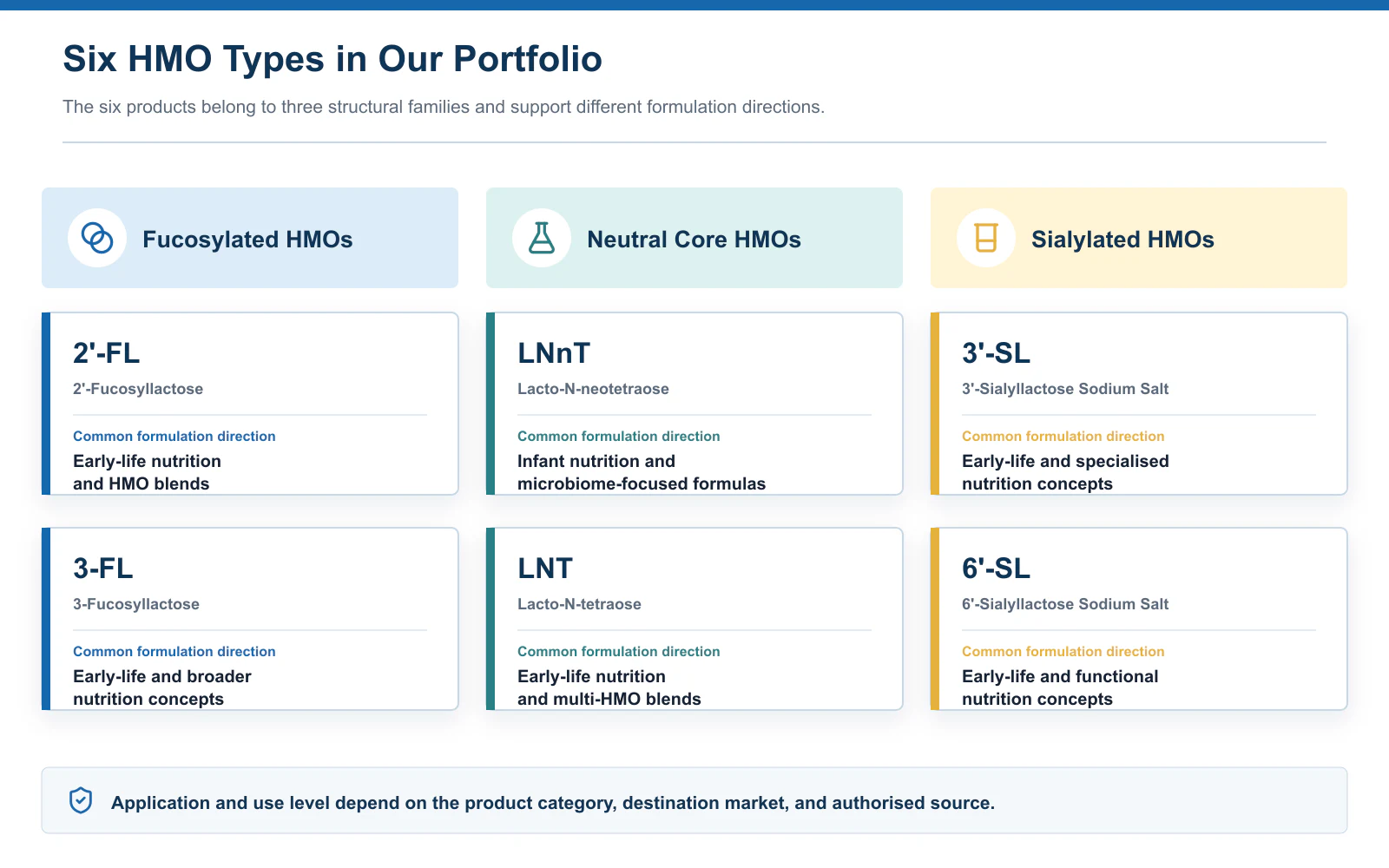
Use this guide as a practical starting point when comparing six HMO types: 2'-FL, 3-FL, LNnT, LNT, 3'-SL Sodium Salt, and 6'-SL Sodium Salt. Use a formal assessment, an approved product label, and market-specific advice before a commercial launch.
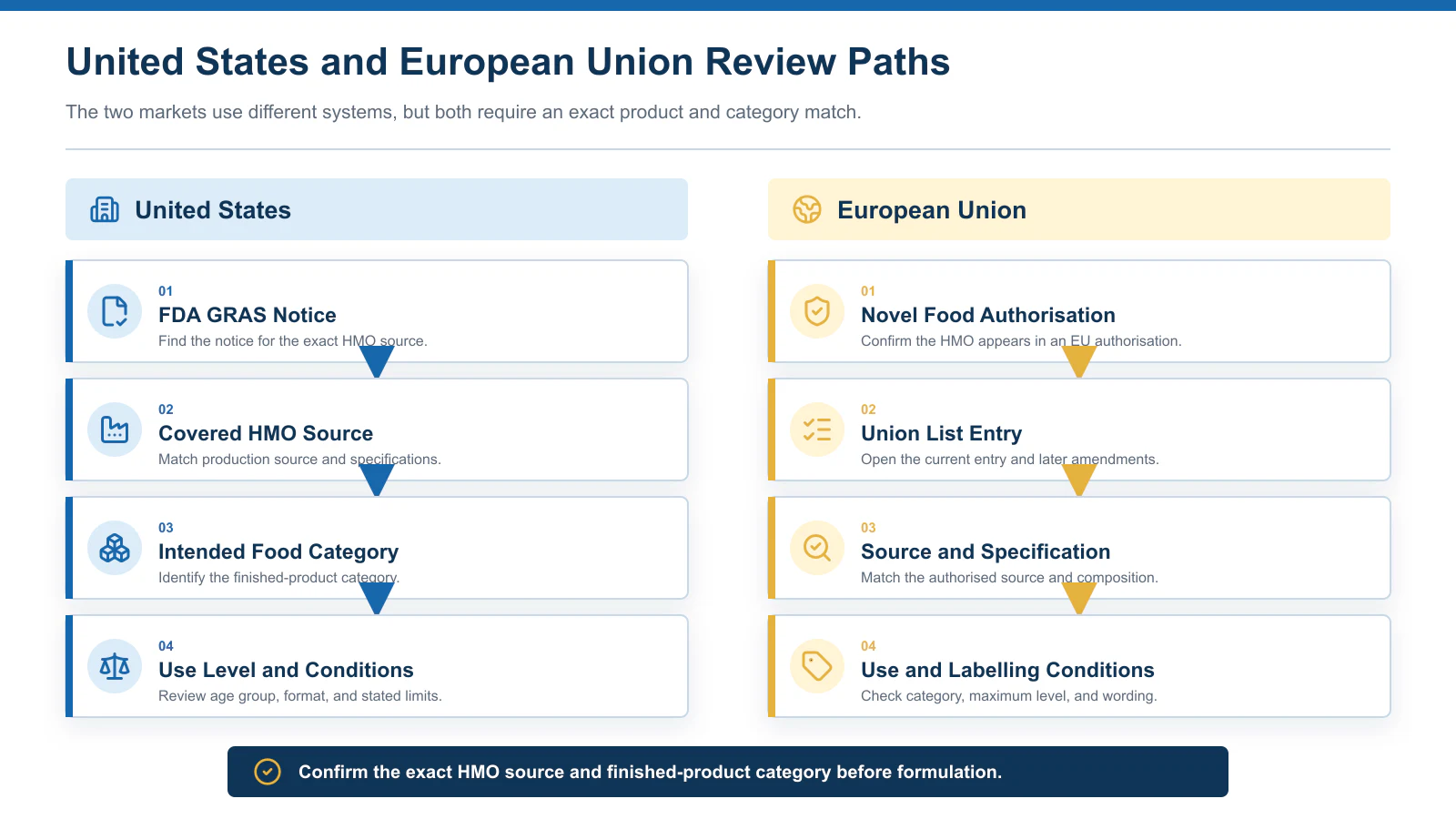
GRAS means Generally Recognized as Safe. Each FDA notice covers a defined ingredient source and lists intended uses and use levels. One notice may set different limits for infant formula, young-child formula, beverages, foods, and oral nutrition products.
The European Union uses a different system. HMOs must appear in the Union List of authorised novel foods. An entry may depend on the production source, strain, specifications, conditions of use, labelling, or temporary protection for supporting data. Products with the same HMO name may have different EU market status when their production sources, specifications, or authorised uses differ.
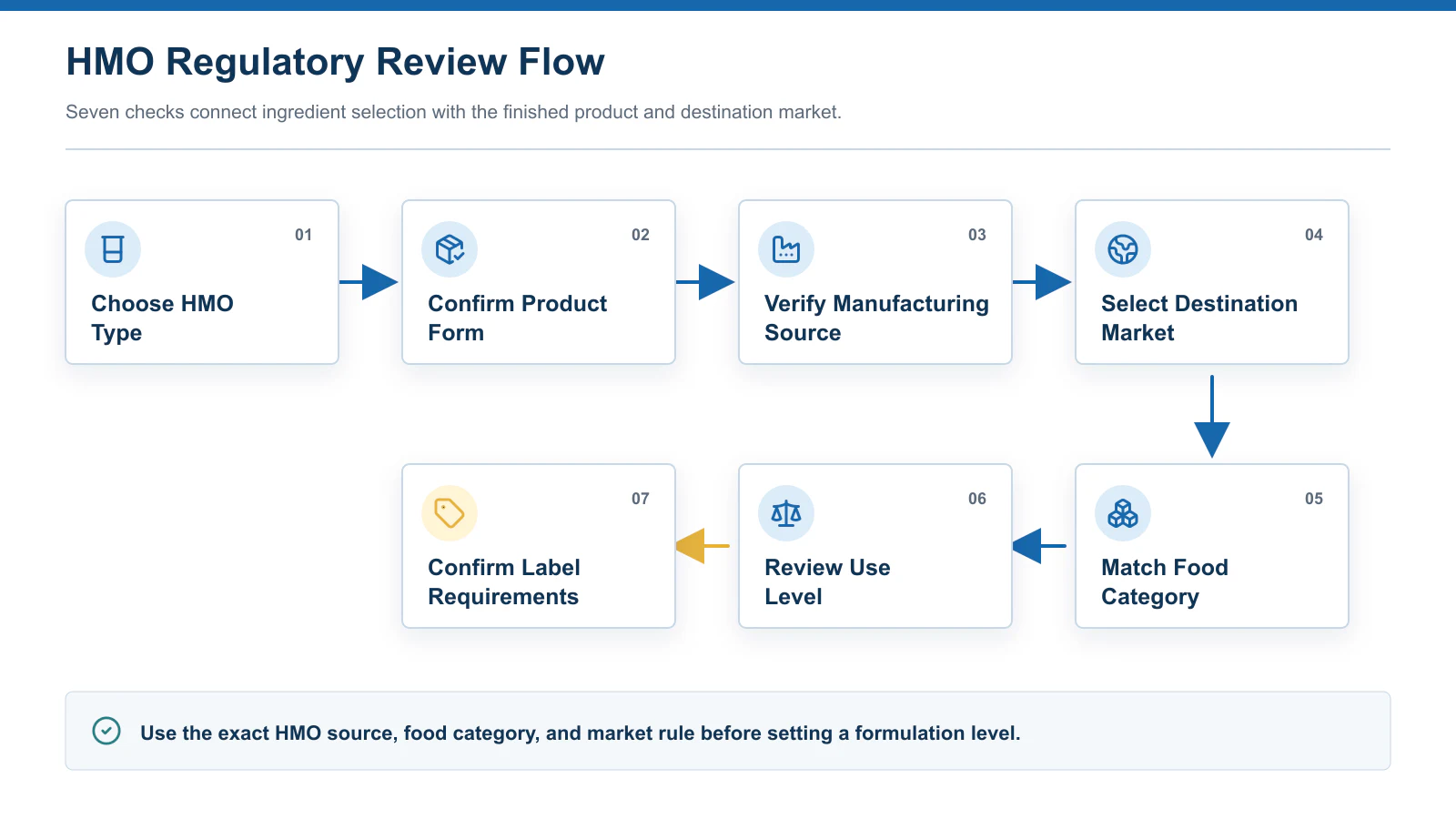
For formulation work, confirm the exact HMO type, product form, and manufacturing source before comparing HMO use-level numbers from different FDA notices. Those use-level numbers may apply to different product sources or food categories.
United States
U.S. FDA Reference Table
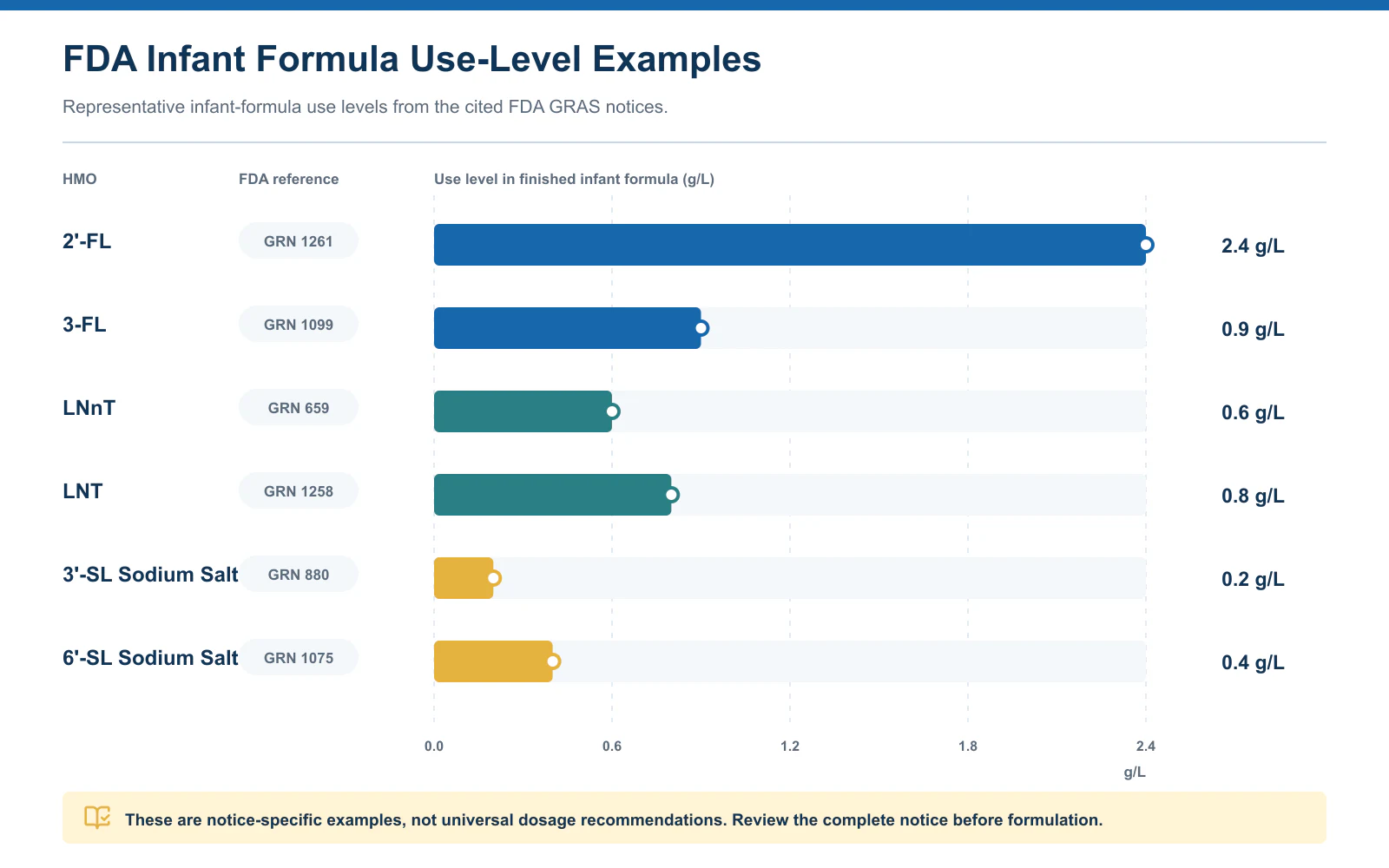
Use the table below to compare example use levels from FDA GRAS notices. Open the complete notice and response letter before using any value in a formulation.
| HMO | FDA Reference | Infant Formula Example | Other Representative Uses | Review Note |
|---|---|---|---|---|
| 2'-FL | GRN 1261 | Up to 2.4 g/L | The notice lists other food categories with category-specific limits. | Check the complete category table and the exact source covered by the notice. |
| 3-FL | GRN 1099 | Up to 0.9 g/L | Young-child formula up to 1.2 g/L; oral and enteral tube feeding products for ages 11+ up to 6.6 g/L. | The notice includes separate limits for infant foods, beverages, bars, dairy formats, and supplements. |
| LNnT | GRN 659 | Up to 0.6 g/L | Selected foods and beverages from 0.02 to 3 g/serving. | Confirm that the proposed use fits the food category described in the notice. |
| LNT | GRN 1258 | Up to 0.8 g/L | Other food categories up to 20 g/L, subject to the notice. | Review the complete GRN package before using the number in a formulation. |
| 3'-SL Sodium Salt | GRN 880 | Up to 0.2 g/L | Young-child formula up to 0.15 g/L; infant and young-child foods up to 1.25 g/kg; yogurt up to 2.5 g/kg. | Match the sodium salt identity and exact food format during specification review. |
| 6'-SL Sodium Salt | GRN 1075 | Up to 0.4 g/L | Young-child formula up to 0.3 g/L; infant and young-child foods up to 2.5 g/kg; yogurt up to 5 g/kg. | Review beverage, bar, milk, and soft-drink conditions before applying the data. |
HMO use levels depend on the product category, age group, and finished-product format. Do not apply one dosage value across an entire product range.
European Union
European Union Reference Map
In the European Union, only novel foods authorised and included in the Union List may be placed on the market. Use the EU Union List page to locate the relevant rules and later updates.
- 2'-FL: Regulation (EU) 2024/2036 and Regulation (EU) 2024/2102
- 3-FL: Regulation (EU) 2023/52 and Regulation (EU) 2023/2210
- LNnT: Regulation (EU) 2023/961
- LNT: Regulation (EU) 2020/484 and the newer source-specific Regulation (EU) 2026/397
- 3'-SL Sodium Salt: Regulation (EU) 2021/96 and later source updates including Regulation (EU) 2023/113
- 6'-SL Sodium Salt: Regulation (EU) 2021/82 and later source-specific amendments such as Regulation (EU) 2023/948
For a commercial product, compare the proposed manufacturing source, specification, authorised food category, maximum level, and required product name with the applicable EU entry. Some entries also give one company temporary protection for its supporting data.
Practical Conclusions
What This Means for Nutrition Companies
Start with the Destination Market
The same HMO type may follow a different path in the United States and European Union. Start with the country or region where the finished food will be sold.
Match the Finished-Product Category
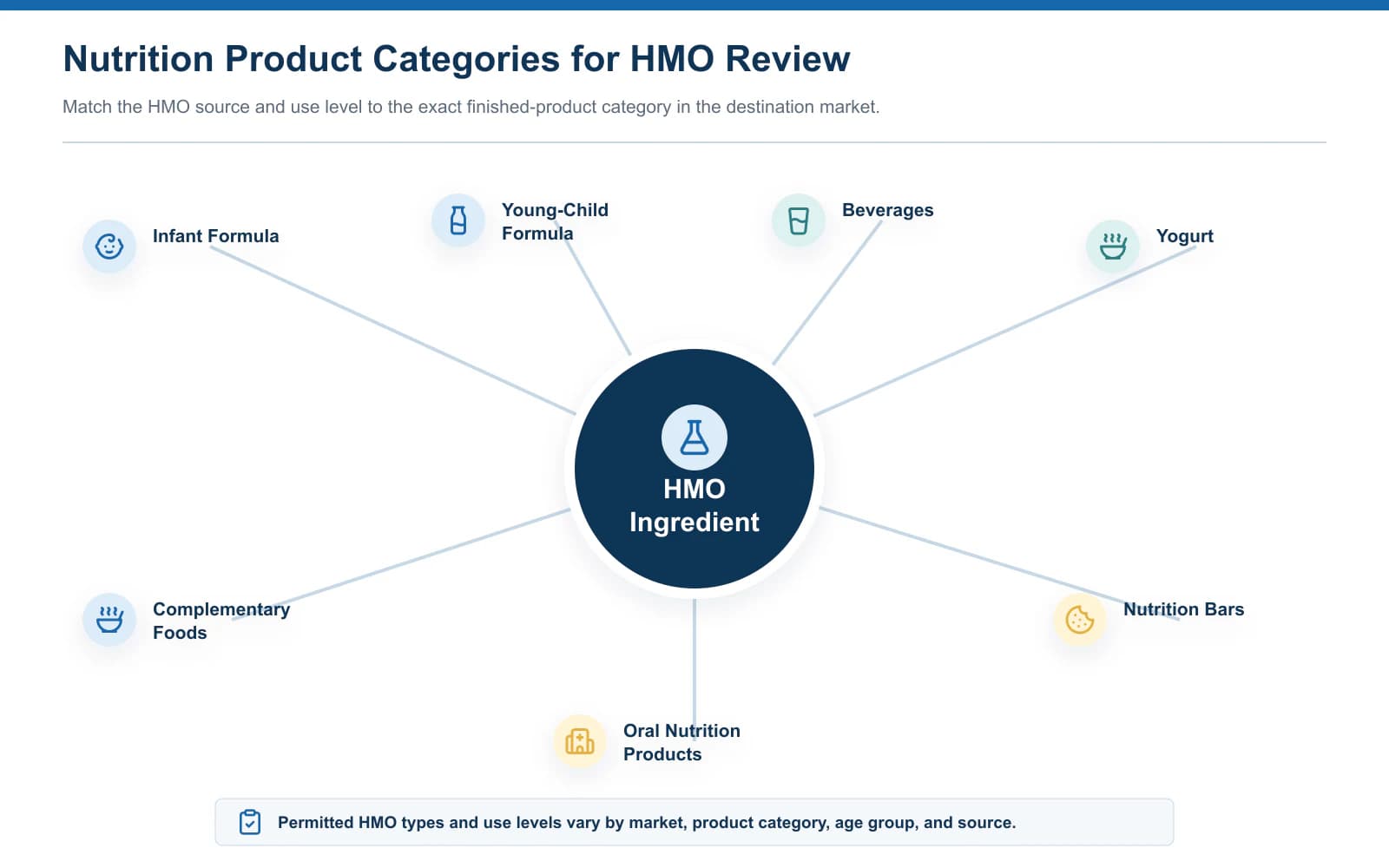
Infant formula, beverages, yogurt, bars, oral nutrition products, and complementary foods do not share one universal use level.
Check the Source and Specification
Compare identity, purity test method, impurity limits, process residues, microbiological limits, sodium form where applicable, and production source.
Separate Use Level from Marketing Claim
A permitted use level does not approve a health claim, product positioning, or finished-product label. Review each item separately for the destination market.
Keep a Document Trail
Retain the regulation or GRN link, version date, specification, source statement, proposed food category, and your team's conclusion.
Project Checklist
Our Practical Review Path
- Confirm the HMO type, CAS number, salt form, and production source.
- Identify the destination country and finished-product category.
- Check the relevant FDA notice or EU Union List entry.
- Compare the proposed level with the applicable category and age group.
- Review the specification, purity, process residues, microbiological limits, packaging, and stability information.
- Confirm labelling and claim requirements for the destination market.
- Keep the source documents and review conclusion with the product development file.
We help nutrition companies choose a suitable HMO type, discuss the intended application, arrange samples, and review specifications. Your formulation team can then use this information to confirm the final formula and market requirements.