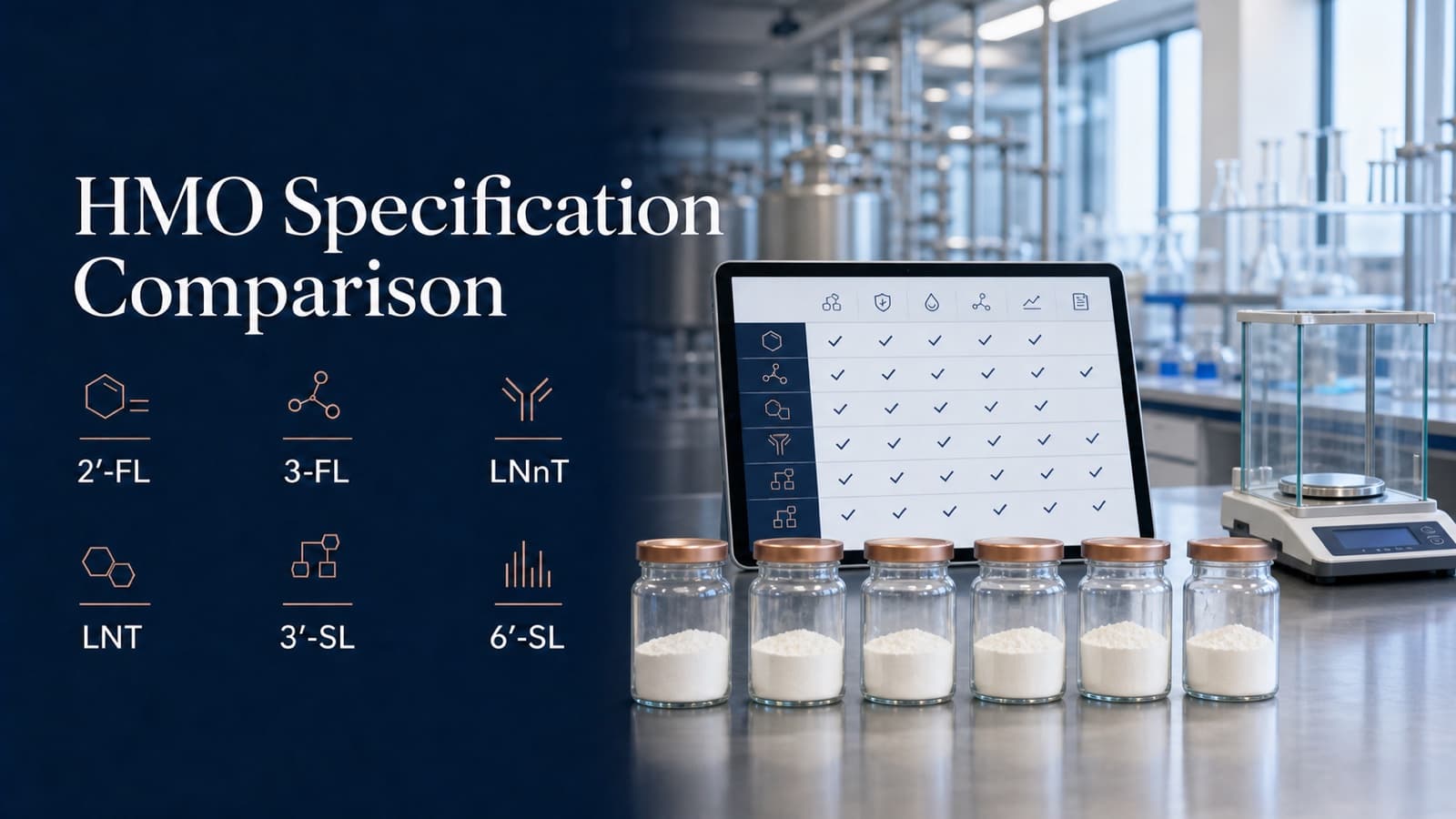
As a purchasing manager at a nutrition company, you may open six HMO specification sheets expecting the assay percentages to reveal the differences. Instead, you find different calculation bases and different limits for water, lactose, related carbohydrates, and process residues. The highest percentage on the page therefore does not automatically identify the best product.
Our portfolio includes six common HMO types: 2'-FL, 3-FL, LNnT, LNT, 3'-SL Sodium Salt, and 6'-SL Sodium Salt. Each has its own molecular identity and specification. Their target assays differ partly because the products belong to three structural families and require different purification and analytical controls.
Start by confirming product identity and assay basis. Then compare related carbohydrates, water, residual controls, microbiological limits, and the test method used for batch release. This gives purchasing, quality, and R&D teams a clearer basis for deciding whether an HMO fits their formulation and quality requirements.
Assay means the measured amount of the named HMO. It does not describe the complete quality profile by itself. Water, related carbohydrates, residuals, microorganisms, and identity tests remain part of the release decision.
Identity
Confirm the full product name, molecular form, and CAS number.
Assay
Read the target HMO percentage together with its calculation basis.
Related Carbohydrates
Review the sugars and oligosaccharides that are specific to that HMO.
Residual Controls
Check residual protein, endotoxins, and other process-related limits.
Microbiology
Match microbiological limits with the finished product and consumer group.
Side-by-Side Specification Review
Six HMO Specifications at a Glance
When you place the six specification sheets side by side, the assay values are the most visible difference. They range from at least 80.0% for LNT to at least 94.0% for 2'-FL, but those figures do not use one universal comparison standard. The table keeps each assay beside its calculation basis, water limit, lactose limit, and related-carbohydrate profile.
| HMO | Family | Target Assay | Assay Basis | Water or Moisture | D-Lactose | Representative Related-Carbohydrate Limits |
|---|---|---|---|---|---|---|
| 2'-FL | Fucosylated | At least 94.0% | Water-free | No more than 5.0% | No more than 3.0% | Difucosyllactose: no more than 2.0% |
| 3-FL | Fucosylated | At least 90.0% | Water-free | No more than 9.0% | No more than 3.0% | L-Fucose: no more than 3.0%; D-galactose and D-glucose: no more than 2.0% |
| LNnT | Neutral core | At least 92.0% | Dry matter | No more than 8.0% | No more than 3.0% | Fructose isomer: no more than 1.0%; Lacto-N-triose II and linear LNnH: each no more than 3.0% |
| LNT | Neutral core | At least 80.0% | Water-free | No more than 9.0% | No more than 5.0% | Lacto-N-triose II: no more than 5.0%; other carbohydrates: no more than 15.0% |
| 3'-SL | Sialylated sodium salt | At least 88.0% | Water-free | No more than 10.5% | No more than 3.0% | 3'-Sialyllactulose: no more than 5.0%; N-acetylneuraminic acid: no more than 1.5% |
| 6'-SL | Sialylated sodium salt | At least 90.0% | Confirm on the controlled specification | No more than 10.5% | No more than 0.5% | 6'-Sialyllactulose and 3'-SL Sodium Salt: combined no more than 5.0%; N-acetylneuraminic acid: no more than 2.0% |
Do not sort these products by assay percentage and treat the result as a quality ranking. For example, the LNT specification allows more types and a higher combined amount of related carbohydrates than the 2'-FL specification because the two products and processes differ. Compare a batch with the specification for that HMO, not with the assay target of another HMO.
When the Percentages Look Comparable
Why the Percentage Alone Is Not Enough
If your shortlist shows a minimum assay of 94.0% for 2'-FL, 92.0% for LNnT, and 80.0% for LNT, it is tempting to rank them from highest to lowest. That comparison is misleading. Each percentage refers to a different molecule and may use a different calculation basis. Check whether the result uses a water-free, dry-matter, or as-is basis before comparing it with another number.
What Water-Free and Dry-Matter Basis Mean
A water-free or dry-matter result expresses the target HMO as a percentage of the non-water part of the sample. The laboratory measures water separately, then calculates the HMO percentage without counting that water in the total. The terms often describe the same practical idea, but the controlled method and formula still need confirmation.
An as-is result uses the powder in its received condition, including its water. For that reason, a water-free assay should not be compared directly with an as-is assay. Our current 6'-SL specification states the target assay but does not use the same water-free label shown on several other sheets, so the controlled specification and test method should confirm the basis before a numerical comparison.
Water Changes an As-Is Result
If a powder contains 5% water, the non-water portion equals 95% of the powder. A target-HMO result calculated on that non-water portion will be higher than the same amount reported on the full as-is powder weight.
Keep Assay and Water Together
Review the assay basis, water result, analytical method, and calculation formula as one set. Do not lift the assay percentage out of the specification and compare it alone.
Where Direct Comparison Is Possible
Five Release Controls Shared Across All Six HMOs
Not every row differs by product. Our six current specifications share the five limits below, so a quality team can compare this baseline directly before reviewing the extra tests required for a particular HMO or finished-product application.
CFU means colony-forming units, a laboratory estimate of viable microorganisms. EU in the endotoxin result means endotoxin units, not European Union. Endotoxins are components associated with certain bacterial cell walls, so fermentation-derived ingredients include a defined endotoxin limit.
Several specifications add further organisms or residue tests, such as Cronobacter, Listeria monocytogenes, Bacillus cereus, Staphylococcus aureus, exogenous DNA, or viable production-cell residues. The additional panel should match the HMO, production process, finished-product category, and consumer group.
Before Comparing Any Result
Product Identity Still Comes First
First confirm that every document refers to the intended HMO. 2'-FL and 3-FL share a molecular formula and mass, as do LNnT and LNT, but their sugar units connect at different positions. The full product name, CAS number, and laboratory identity method separate each ingredient.
| Product | CAS Number | Molecular Formula | Relative Molecular Mass |
|---|---|---|---|
| 2'-Fucosyllactose (2'-FL) | 41263-94-9 | C18H32O15 | 488.44 |
| 3-Fucosyllactose (3-FL) | 41312-47-4 | C18H32O15 | 488.44 |
| Lacto-N-neotetraose (LNnT) | 13007-32-4 | C26H45NO21 | 707.63 |
| Lacto-N-tetraose (LNT) | 14116-68-8 | C26H45NO21 | 707.63 |
| 3'-Sialyllactose Sodium Salt (3'-SL) | 128596-80-5 | C23H38NO19Na | 655.53 |
| 6'-Sialyllactose Sodium Salt (6'-SL) | 157574-76-0 | C23H38NNaO19 | 655.53 |
A nutrition company should match the specification, sample label, COA, safety record, and purchase order to the same full identity. An abbreviation such as "SL" or "FL" is not precise enough for release or regulatory review.
During Supplier Qualification
Specification, COA, and Regulatory Status Serve Different Purposes
These records often arrive together during supplier qualification, which makes them easy to treat as one document package. They answer different questions: the specification defines acceptance limits, the COA reports one lot, and the regulatory record addresses where and how the ingredient may be used. One cannot replace another.
Specification
A specification lists the identity, test methods, and acceptance limits for a product. It defines what every manufactured batch must meet before release.
Certificate of Analysis
A Certificate of Analysis, or COA, lists the test results for one production lot. Compare its product name, lot number, methods, units, and results with the current specification revision.
Regulatory Status
Regulatory status defines where and how the specific HMO may be used, including its product category, consumer group, maximum amount, and labelling conditions. Meeting our product specification does not provide market authorization by itself.
In the United States, an ingredient review covers identity, specifications, and limits on the conditions of use; see the FDA guide to determining food-ingredient status. In the EU, a novel food application must include scientific information for the specific novel food under review; see the EFSA novel food application procedure. Links reviewed July 14, 2026.
Use our HMO use-level and regulatory guide for product-specific U.S. FDA and EU references. Keep that market review separate from the technical comparison in this article.
After You Receive the Documents
How Nutrition Companies Can Review an HMO Specification
When quotations, samples, and documents arrive from more than one potential supplier, reviewing them in a random order makes discrepancies difficult to trace. Start with identity, move to the specification and batch evidence, and finish with a trial in the actual formulation.
- Confirm Product Identity
Use the full HMO name, abbreviation, CAS number, and molecular form. For 3'-SL and 6'-SL, confirm that the document covers the sodium salt.
- Confirm the Assay Basis
Check whether the assay uses a water-free, dry-matter, or as-is calculation. Do not compare percentages until the calculation basis is clear.
- Review the Carbohydrate Profile
Compare the target HMO result with the product-specific related carbohydrates. Each HMO needs a different profile.
- Review Chemical and Residual Limits
Check water, residual protein, endotoxins, heavy metals, and any process-specific residue tests required for the project.
- Review Microbiological Limits
Match the microbial panel with the finished-product category, consumer age group, manufacturing process, and destination-market requirements.
- Check One Batch in Detail
Compare the controlled specification with the sample COA, then verify the method, unit, lot number, and specification revision.
- Complete the Formulation Trial
Run the HMO in the real formulation and process. Confirm solubility, taste, color, heat exposure, pH, moisture, and shelf-life conditions.
Compare the Exact HMO, Then Test the Real Formula
Tell us about your finished product and quality requirements. We can recommend a suitable HMO type, explain the relevant specification, and provide a sample for your formulation trial before you move to a commercial order.
Discuss an HMO Specification