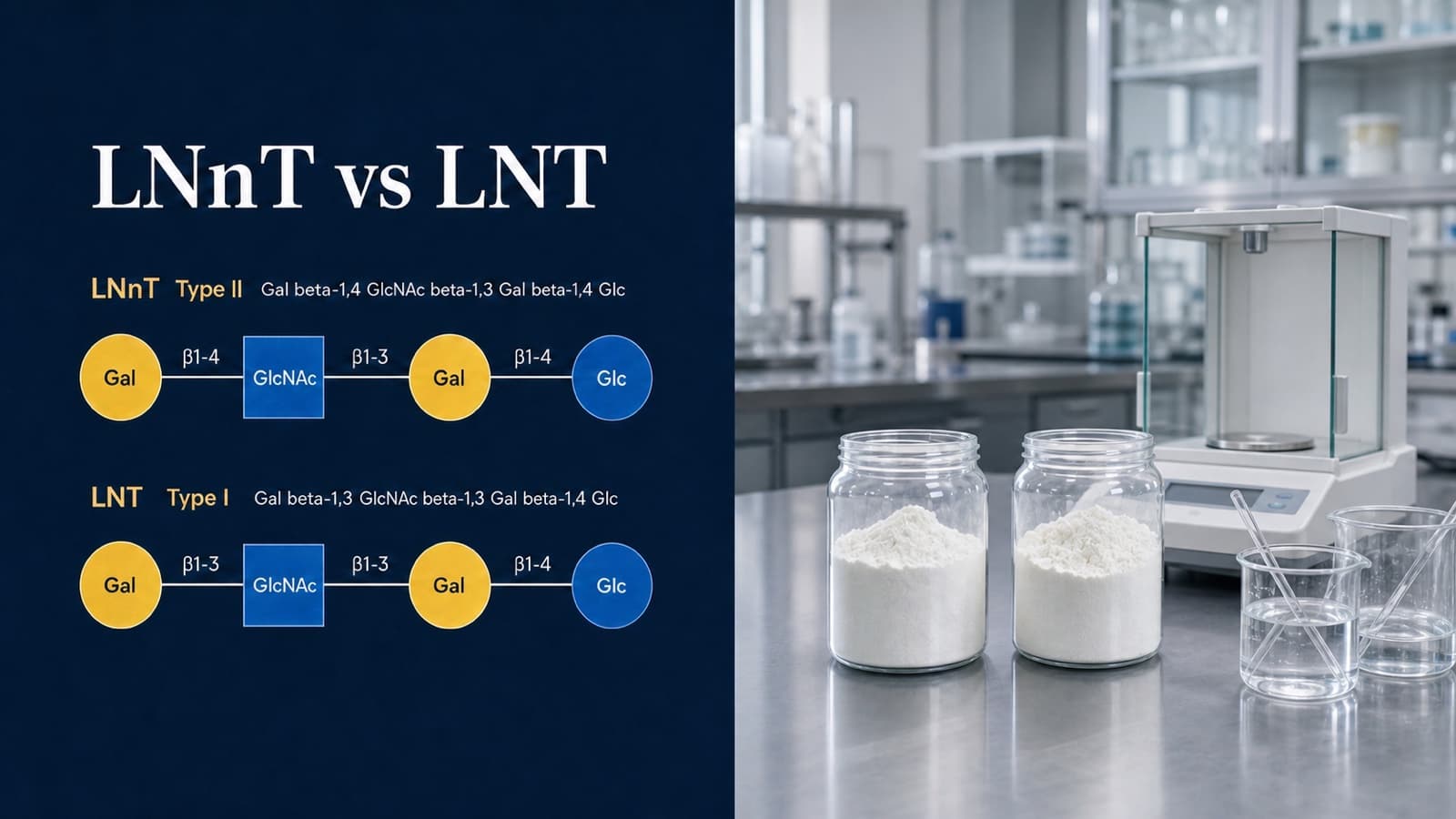
Lacto-N-neotetraose (LNnT) and lacto-N-tetraose (LNT) are both neutral tetrasaccharide HMOs, but a nutrition company should treat them as separate formulation ingredients. LNnT has a Type II neutral core, while LNT has a Type I core.
Both molecules contain the same four sugar units and share the molecular formula C26H45NO21 and relative molecular mass 707.63. In LNT, terminal galactose attaches to N-acetylglucosamine through a beta-1,3 linkage, while LNnT uses beta-1,4 at that position.
That one structural change gives them separate CAS numbers, analytical identities, specifications, microbial responses, and regulatory records. Their molecular formula and molecular mass cannot identify which HMO is present. Before substituting one for the other, check the supporting evidence and test the change in the finished formula.
Match the ingredient to the finished product and the evidence behind it. Begin with LNnT when the supporting study or blend design specifies a Type II core. Choose LNT when the formula needs a Type I core or uses LNT-specific research. Include both only when the product design calls for both neutral core structures.
LNnT and LNT at a Glance
| Point of Comparison | LNnT | LNT |
|---|---|---|
| Full Name | Lacto-N-neotetraose | Lacto-N-tetraose |
| Neutral Core Type | Type II | Type I |
| Condensed Structure | Gal beta-1,4 GlcNAc beta-1,3 Gal beta-1,4 Glc | Gal beta-1,3 GlcNAc beta-1,3 Gal beta-1,4 Glc |
| Terminal Galactose Connection | Beta-1,4 to GlcNAc | Beta-1,3 to GlcNAc |
| CAS Number | 13007-32-4 | 14116-68-8 |
| Molecular Formula | C26H45NO21 | C26H45NO21 |
| Relative Molecular Mass | 707.63 | 707.63 |
| Our Current Target Assay | At least 92.0% on a dry-matter basis | At least 80.0% on a water-free basis |
One Different Bond
One Linkage Creates Two Different HMOs
A linkage describes the position and direction of the bond between two sugar units. LNnT and LNT both contain one glucose unit, two galactose units, and one N-acetylglucosamine unit. N-acetylglucosamine is often shortened to GlcNAc.
LNnT
The terminal galactose connects to GlcNAc through beta-1,4.
LNT
The terminal galactose connects to GlcNAc through beta-1,3.
LNT forms a Type I core, whereas LNnT forms a Type II core. Because their terminal linkages differ, bacterial transporters and enzymes may recognize and break down the two HMOs differently. The result depends on the bacterial strain.
A common biosynthetic route first adds N-acetylglucosamine to lactose to form Lacto-N-triose II. A beta-1,3 galactosyltransferase can then form LNT, while a beta-1,4 galactosyltransferase can form LNnT. The final transferase determines which neutral core structure the process produces.
Because LNnT and LNT share the same formula and molecular mass, those fields cannot identify the product. A quality laboratory needs a validated method that separates the two structures and checks each result against the correct reference standard.
Current Product Specifications
The Same Formula Does Not Mean the Same Specification
Do not choose between LNnT and LNT by assay percentage alone. First confirm which HMO the method measures and how the laboratory calculates the result. Then compare lactose, product-specific related carbohydrates, moisture, ash, process residues, contaminants, and microbiological limits.
Assay means the measured percentage of the named HMO. Read it together with its calculation basis and the limits for related carbohydrates.
Our current specifications set LNnT at no less than 92.0% on a dry-matter basis and LNT at no less than 80.0% on a water-free basis. Both calculations exclude measured water from the assay, but the test method still determines the reported result.
The related-carbohydrate profile also differs. Our LNnT specification controls an LNnT fructose isomer, Lacto-N-triose II, linear LNnH, and D-lactose. Our LNT specification controls Lacto-N-triose II, linear LNnH II and para-LNnH II, D-lactose, free galactose and glucose, and other carbohydrates.
| Specification Item | LNnT | LNT |
|---|---|---|
| Target HMO | LNnT, dry matter: >=92.0% | LNT, water-free: >=80.0% |
| D-Lactose | <=3.0% | <=5.0% |
| Lacto-N-triose II | <=3.0% | <=5.0% |
| Other Product-Specific Carbohydrates | Fructose isomer <=1.0%; linear LNnH <=3.0% | Linear LNnH II and para-LNnH II <=5.0%; other carbohydrates <=15.0% |
| Water or Moisture | Water <=8.0% | Moisture <=9.0% |
| Ash | <=0.4% | <=1.0% |
| Residual Protein | <=100 mg/kg | <=100 mg/kg |
| Endotoxins | <=10 EU/mg | <=10 EU/mg |
| Aerobic or Total Plate Count | <=500 CFU/g | <=500 CFU/g |
| Enterobacteriaceae | <10 CFU/g | <10 CFU/g |
| Salmonella | Absent in 25 g | Absent in 25 g |
Both current specifications use the same limits for residual protein, endotoxins, aerobic or total plate count, Enterobacteriaceae, and Salmonella. The LNnT specification includes additional release tests. A quality team should compare the full specifications and test methods instead of counting rows in this summary table.
Our six-product HMO specification article explains assay basis, related carbohydrates, identity, and batch COA review in more detail.
Strain-Specific Screening
How the Structural Difference Affects R&D
Microbial enzymes recognize specific sugar linkages. A probiotic strain may therefore use LNT and LNnT differently even though the two HMOs contain the same sugar units.
A synbiotic product combines a substrate, such as an HMO, with one or more live microorganisms. Test the intended HMO and probiotic as a pair.
Bifidobacterium breve UCC2003 transported and broke down both HMOs through overlapping but distinct pathways. In a separate Bifidobacterium infantis ATCC 15697 experiment, LNT produced a final optical density of 1.19 plus or minus 0.24, compared with 0.85 plus or minus 0.09 for LNnT under the tested growth conditions.
These laboratory results do not show that LNT works better than LNnT in people. They help an R&D team decide which HMO-probiotic pair deserves further testing. Use the selected strain, planned HMO amount, complete product formula, and intended storage conditions in the next experiment.
Do Not Generalize by Species Name
Different strains within a Bifidobacterium species can carry different transporters and enzymes. A result from one strain does not predict how every commercial strain will respond.
Test the Actual HMO-Probiotic Pair
Measure probiotic growth or metabolism with LNnT, LNT, and the planned blend. Repeat the experiment in the final formula because proteins, minerals, pH, and water activity can change the result.
Formulation Direction
Where LNnT and LNT Fit in Nutrition Products
Nutrition companies may evaluate LNnT and LNT for early-life products, multi-HMO blends, synbiotic formulas, adult nutrition, and specialized products. A research paper does not authorize a commercial use or support a finished-product health claim. The manufacturing source, product category, consumer age group, and amount must fit the rules in your market.
Early-Life Formulation
Official records include LNnT and LNT in selected infant and young-child products. Before formulating, match the exact manufacturing source, product category, age group, and proposed amount with the rules in your market.
Synbiotic R&D
A probiotic strain may metabolize LNT and LNnT differently. Test the actual HMO-probiotic pair instead of treating both neutral core HMOs as the same substrate.
Multi-HMO Formulas
Either ingredient can add a neutral core HMO beside fucosylated and sialylated structures. Set an amount and analytical target for every HMO in the blend.
Adult and Specialized Nutrition
Some source-specific records include foods, drinks, supplements, meal replacements, and foods for special medical purposes. Check the permitted categories for the exact ingredient source.
When LNnT Fits the Formula
Consider LNnT when the product brief, supporting study, or blend design calls for a Type II neutral core HMO. LNnT also appears beside 2'-FL in published formulations. For the sources and uses covered by Regulation (EU) 2023/961, the EU no longer requires the former 1:2 LNnT-to-2'-FL ratio.
When LNT Fits the Formula
Select LNT when the formula requires a Type I neutral core, the planned blend names LNT, or strain screening favors LNT in a synbiotic product. U.S. and EU records include infant nutrition and selected broader food categories, but the permitted uses differ by manufacturing source.
When a Formula Uses Both
Combine LNnT and LNT only when the formula has a clear reason to include both core types and your market permits each source at the proposed amount. Set a separate target for each HMO, then measure both after processing and during shelf life.
United States
U.S. FDA Records for LNnT and LNT
FDA GRAS notices cover specific ingredient sources and proposed uses. In this comparison, GRN 1067 lists one LNnT source, while GRN 1258 covers one LNT source. Their listed use levels are not recommended amounts for every commercial LNnT or LNT ingredient.
FDA GRN 1067
This notice lists LNnT in nonexempt formula for term infants up to 0.60 g/L. It also includes category-specific levels for young-child products, drinks, yogurt, meal replacement beverages, and meal replacement bars.
FDA GRN 1258
This notice lists LNT in nonexempt formula for term infants at 0.8 g/L and in other food categories at levels up to 20 g/L. FDA issued its no-questions response on April 16, 2026.
These two infant-formula amounts come from separate notices and ingredient sources. The higher LNT number does not show that LNT works better than LNnT. Before launch, match your ingredient and finished product with the applicable record.
European Union
EU Authorizations Depend on the Exact Production Source
An EU authorization can define the production organism, specification, food categories, maximum levels, label statements, and data-protection period for one HMO source. Check the production source as well as the name LNnT or LNT.
LNnT Entries
Regulation (EU) 2023/961, linked above, removed the former fixed 1:2 LNnT-to-2'-FL ratio for infant formula, follow-on formula, and certain young-child milk products. Regulation (EU) 2023/1583 updated the specification for a defined microbial LNnT source. Match the source and proposed use with the current Union List entry.
LNT Entries
Regulation (EU) 2020/484 includes LNT at 0.8 g/L in infant formula and 0.6 g/L in follow-on formula, along with category-specific levels for other products. These values apply to the LNT source and conditions covered by that entry.
Regulation (EU) 2026/397 authorizes another defined LNT source in infant formula at 0.8 g/L and follow-on formula at 0.6 g/L. It also lists dairy products, drinks, bars, total diet replacements, foods for special medical purposes, and supplements for people over three years. The data protection for the named applicant runs until March 16, 2031.
Before an EU launch, match the production source, specification, food category, consumer age, maximum level, and label conditions. An authorization for one manufacturing source does not cover every LNnT or LNT ingredient sold under the same short name.
Project Review
How to Choose LNnT, LNT, or Both
- Define the finished product, consumer age group, serving size, and country of sale.
- Decide whether the formula needs a Type I HMO, a Type II HMO, or both.
- Check whether the exact manufacturing source and proposed amount fit the rules in your market.
- Choose LNnT or LNT alone, with 2'-FL, or as part of a wider HMO blend.
- Use an analytical method that identifies and measures LNnT and LNT separately.
- Compare the assay basis and related-carbohydrate limits with your quality requirements.
- For a synbiotic product, screen the selected HMO with the actual probiotic strain.
- Run a pilot batch and measure solubility, processing stability, taste, and shelf-life performance.
Discuss Your LNnT or LNT Formula
We manufacture fermentation-derived LNnT and LNT for nutrition product development. Tell us the finished product, consumer group, target amount, country of sale, and whether the formula needs one neutral core HMO or both. We can compare our specifications, discuss the application, and prepare samples for a formulation trial.
Discuss an LNnT or LNT Project