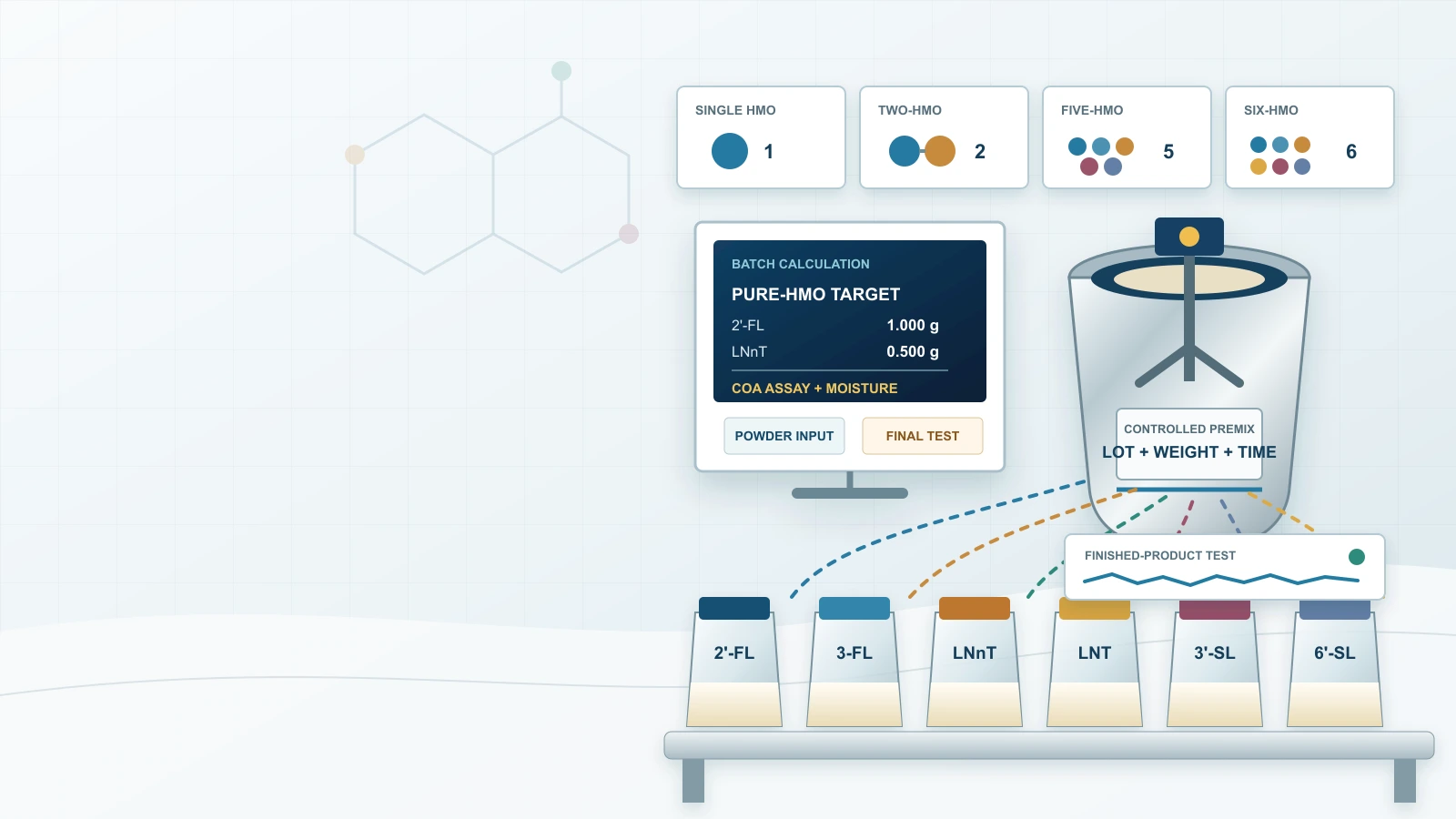
As a formulation developer at a nutrition company, you may face a basic question at the start of a new project: should the finished product contain one HMO or a blend? A six-HMO blend may look more complete on paper, but a longer ingredient list does not automatically make the formula better. Every added HMO changes the amount of powder you need, the blend ratio, cost, market review, and testing plan.
When I compare a single HMO with a blend, I first look at who will use the product, its format and serving size, expected daily intake, production process, shelf life, and where it will be sold. If one HMO fits the product goal and the relevant research, a single-HMO formula may be the clearest choice. I would use a blend only when there is a reason to include each HMO and the development team can measure all of them after production.
Our portfolio includes 2'-FL, 3-FL, LNnT, LNT, 3'-SL Sodium Salt, and 6'-SL Sodium Salt. A formulator can use them individually or in planned blends. In this article, I explain how to read published blend ratios, adjust powder weights using the current batch assay, prepare a premix, and measure each HMO in the finished product.
When I mention a 2:1 or 4:1 HMO ratio, I am describing the formula used in that particular study. It is not the standard ratio for every product, and the study results do not automatically apply to a different HMO combination.
Composition Choices
Single HMO, Two-HMO, Five-HMO, and Six-HMO Formulas
When we describe a formula as containing two, five, or six HMOs, we count only the HMO ingredients added to it. For example, a formula with 2'-FL and LNnT is a two-HMO formula. Lactose, other carbohydrates, and moisture that may be present in an HMO powder are not counted as additional HMOs.
Single-HMO Formula
Choose one HMO when research supports it, your market allows it, and it works well in your product and production process.
Why it may fit: With only one HMO, it is usually easier to set the formula, test method, label, and shelf-life plan.
What to check: Confirm that your market allows that HMO source for the intended use, then test it in the finished product.
Two-HMO Formula
Several human studies use 2'-FL and LNnT together. The ratio varies with the age group and product studied.
Why it may fit: You can compare your proposed formula with studies that used the same two HMOs.
What to check: Keep the ratio, total amount, age group, study length, and product type in mind when reading the results.
Five-HMO Formula
Human studies have tested at least two different five-HMO formulas. One contains 3-FL, while the other contains DFL.
Why it may fit: Human studies have tested both five-HMO combinations shown in this article.
What to check: Saying “five-HMO blend” is not enough. You still need the five names, their amounts, and the intended product.
Six-HMO Formula
A six-HMO formula can contain all six products we supply: 2'-FL, 3-FL, LNnT, LNT, 3'-SL, and 6'-SL.
Why it may fit: It combines two fucosylated, two neutral core, and two sialylated HMOs in one product.
What to check: Adding LNnT makes it different from the published five-HMO formulas. Test the complete six-HMO formula rather than applying a five-HMO study to it.
Five-HMO Does Not Describe One Fixed Blend
The published 5.75 g/L formula discussed in this article contains 2'-FL, 3-FL, LNT, 3'-SL, and 6'-SL. A separate infant study used 2'-FL, DFL, LNT, 3'-SL, and 6'-SL. Neither formula contains LNnT, and the second formula uses DFL rather than 3-FL.
When a nutrition company asks for a five-HMO blend, I would first confirm all five ingredient names. The count alone is not enough. A formula that uses the six HMOs in our portfolio uses a different set of HMOs from both published five-HMO examples. LNT and LNnT also need separate entries because they are different HMOs with different specifications and market approvals.
Application Formulas
Published HMO Formulas for Different Nutrition Products
Before a formulation meeting, I want to see three things together: the HMO names, the amounts, and the product in which they were tested. In term infant formula, published studies have tested 2'-FL alone, 2'-FL with LNnT at 2:1, and two different five-HMO formulas. None of them is a standard formula for every product.
The figures below come from human studies. They are not dosage recommendations or legal limits. Most are grams per liter of prepared formula. The preterm study is different because it calculated the amount from each infant's body weight. Every ratio refers to the actual amount of each HMO, not the powder weight, which changes with assay and moisture.
| Application | HMO Format | Exact Published Formula | How to Read It | Study Source |
|---|---|---|---|---|
| Term Infant Formula | One HMO + GOS | Formula A: 0.2 g/L 2'-FL + 2.2 g/L GOS. Formula B: 1.0 g/L 2'-FL + 1.4 g/L GOS. Each formula provided 2.4 g/L total nondigestible oligosaccharides. | 2'-FL was the only named HMO. GOS was a separate prebiotic ingredient, not a second HMO. | |
| Term Infant Formula | Two HMOs | 1.0 g/L 2'-FL + 0.5 g/L LNnT; pure-HMO ratio 2:1; total HMO concentration 1.5 g/L. | Among the studies in this article, this 2:1 pair appears most often in infant formula. | |
| Term Infant Formula | Five HMOs with 3-FL | Study A: 2.99 g/L 2'-FL + 0.75 g/L 3-FL + 1.50 g/L LNT + 0.23 g/L 3'-SL + 0.28 g/L 6'-SL, totaling 5.75 g/L with a 52:13:26:4:5 ratio. Study B used the same five HMO types at 3.0, 0.8, 1.5, 0.2, and 0.3 g/L, respectively. | The formula includes HMOs from all three structural families, but LNnT is not included. | |
| Term Infant Formula | Five HMOs with DFL | Lower level: 0.87 g/L 2'-FL + 0.10 g/L DFL + 0.29 g/L LNT + 0.11 g/L 3'-SL + 0.14 g/L 6'-SL. Higher level: 1.45, 0.14, 0.48, 0.18, and 0.24 g/L, respectively. The study described the totals as 1.5 and 2.5 g/L. | This is a different five-HMO formula. It uses DFL instead of 3-FL and does not contain LNnT. | |
| Extensively Hydrolyzed Formula | Two HMOs | 1.0 g/L 2'-FL + 0.5 g/L LNnT; pure-HMO ratio 2:1; total HMO concentration 1.5 g/L. | Researchers tested this pair in a specialized formula for infants and young children with confirmed cow's milk protein allergy. | |
| Preterm Neonatal Supplement | Two-HMO liquid supplement | 0.340 g/kg body weight/day 2'-FL + 0.034 g/kg body weight/day LNnT; pure-HMO ratio 10:1; total 0.374 g/kg body weight/day, divided into three portions. | The amount changed with each infant's body weight. It was not a fixed g/L amount in ordinary infant formula. | |
| Follow-Up Formula | One HMO | 1.0 g/L 2'-FL, equivalent to 100 mg/100 mL, in a single test serving for children 8 to 14 months old. | Each child received one test serving. The study measured iron absorption, so it does not set a daily HMO amount for every follow-up formula. | |
| Young-Child Formula | One HMO + GOS | 3.0 g/L 2'-FL + 4.0 g/L GOS. Two 200 mL servings supplied 1.2 g/day 2'-FL and 1.6 g/day GOS. | 2'-FL was the only HMO. The study tested the complete young-child formula for six months in children 1 to 2.5 years old. | |
| Adult Powder Supplement | One HMO or a two-HMO blend | Single-HMO groups used 2'-FL alone or LNnT alone at 5, 10, or 20 g/day. The 2:1 blend used the same total amounts, equal to 3.33 + 1.67, 6.67 + 3.33, or 13.33 + 6.67 g/day of 2'-FL + LNnT. | These were short-term research amounts in healthy adults. They are not general serving recommendations for commercial supplements. | |
| Adult Clinical Supplement Study | Two-HMO blend | 2'-FL + LNnT at 4:1. A 5 g/day blend supplied 4 g + 1 g; a 10 g/day blend supplied 8 g + 2 g. | Researchers tested these amounts for four weeks in adults with IBS. The results do not allow an ordinary food or supplement to claim that it treats IBS. |
There Is No Standard Six-HMO Ratio
I have not found a human study that sets a standard ratio for our exact six-HMO combination: 2'-FL + 3-FL + LNnT + LNT + 3'-SL + 6'-SL. To develop this formula, a nutrition company needs to choose its own target ratio, check whether each HMO is allowed for that use, calculate the powder weights, run a production trial, and measure each HMO after processing.
The published studies also do not give one blend formula to copy for gummies, bars, yogurt, beverages, or general dietary supplements. I would start with who will use the product, the daily serving, which HMO sources and uses are allowed in the market, and whether the laboratory can accurately measure each HMO in that product.
A study formula is a starting point for review, not a recipe to copy. Check that the consumer group, product type, HMO source, daily amount, market rules, and process match your project. Then test every HMO in the finished product.
Understanding Ratios
An HMO Ratio Can Mean Three Different Things
A ratio such as 2:1 is incomplete unless it says what is being compared. It may describe the planned amounts of the two HMOs, the weights of the two powders, or the amounts found in the finished product. Mixing up these three ratios can lead to the wrong batch or label.
Planned HMO Amounts
This is the planned amount of each actual HMO before allowing for water and other substances in the powder. A target of 1.0 g 2'-FL and 0.5 g LNnT has a ratio of 2:1.
Actual Ingredient Weights
This is the weight of each HMO powder added to the mixer. A powder that contains less target HMO or more water requires a higher weight, so this ratio may not remain 2:1.
Measured Amounts after Processing
This is what the laboratory finds after production. Powder loss, uneven mixing, processing, sampling, and the test method can move the result away from the target.
Calculate the Powder Weight from the Batch Assay
The assay tells you what percentage of the powder is the target HMO. If the COA says “water-free” or “dry matter,” that percentage does not include water. Before production, you therefore need to calculate how much target HMO is present in the powder as packed.
HMO fraction in the packaged powder = dry-basis assay fraction × (1 − moisture fraction). Powder to weigh = target HMO amount ÷ HMO fraction in the packaged powder. If the COA reports the assay “as is,” it already includes the water, so do not correct for moisture again.
| Input | Target HMO Amount | Example Batch Result | HMO in Packaged Powder | Powder to Weigh |
|---|---|---|---|---|
| 2'-FL | 1.000 g | 96.0% water-free assay; 3.0% water | 0.960 × 0.970 = 0.9312 | 1.000 ÷ 0.9312 = 1.074 g |
| LNnT | 0.500 g | 94.0% dry-matter assay; 5.0% water | 0.940 × 0.950 = 0.8930 | 0.500 ÷ 0.8930 = 0.560 g |
The HMO target is still 2:1, but the powder weights in this example have a ratio of about 1.92:1 because the two powders have different assay and moisture results. The total powder weight is 1.634 g, not 1.500 g. This is only a calculation example. Use the current batch COA and your actual finished-product target for production.
Published Examples
HMO Blend Ratios Used in Human Studies
The two-HMO pair that appears most often in the studies below is 2'-FL + LNnT. Researchers tested it at 2:1, 4:1, and 10:1, but each ratio was used with a different group of people or type of product. The five-HMO studies also used different HMO combinations.
Here, “common” only means that a combination appears in more than one study or that a study gives the exact HMO names and amounts. It does not mean every nutrition product should use the same formula. Before using an example, check the amounts, who took part in the study, the type of product, and how long the study lasted.
| HMO Combination | Ratio | Tested Amount | Who and What Was Studied | How to Read the Result | Study Link |
|---|---|---|---|---|---|
| 2'-FL + LNnT | 2:1 | 1.0 g/L 2'-FL + 0.5 g/L LNnT | Randomized infant-formula study that evaluated growth and tolerance in healthy term infants. | The study tested this exact 2:1 formula in healthy term infants. It does not make 2:1 the required ratio for every infant formula or adult product. | Two-HMO infant study |
| 2'-FL + LNnT | 2:1 | 5, 10, or 20 g/day total HMO | Randomized study in healthy adults that tested 2'-FL, LNnT, and a 2:1 blend for two weeks. | The amounts came from a two-week adult study. They are not standard daily amounts for commercial products, and the study does not support every possible product claim. | Healthy-adult HMO study |
| 2'-FL + LNnT | 4:1 | 5 or 10 g/day total HMO | Randomized controlled study in adults with irritable bowel syndrome for four weeks. | The results apply to the 4:1 blend and the people in this study. They do not allow an ordinary food or supplement to claim that it treats IBS. | Randomized 4:1 blend study |
| 2'-FL + LNnT | 10:1 | 0.374 g/kg body weight/day total HMO | Randomized liquid-supplement study in pre-term infants during neonatal-unit care. | This was a weight-based supplement given under hospital care. Its ratio and daily amount are not standards for ordinary infant formula. | Pre-term infant 10:1 study |
| 2'-FL + 3-FL + LNT + 3'-SL + 6'-SL | 52:13:26:4:5 | 5.75 g/L total HMO | Randomized infant-formula study using 2.99, 0.75, 1.50, 0.23, and 0.28 g/L of the five HMOs. | The study tested this exact five-HMO formula. It contains LNT but not LNnT. | Five-HMO infant study |
| 2'-FL + DFL + LNT + 3'-SL + 6'-SL | Component levels varied by study group | 1.5 or 2.5 g/L total HMO | Randomized infant-formula study that measured microbiota and gut-maturation markers. | This five-HMO formula is different from the one above. It contains DFL instead of 3-FL and does not contain LNnT. | Alternative five-HMO infant study |
Human Milk Does Not Have One Fixed HMO Ratio
The amount of each HMO in human milk varies from one mother to another and changes during lactation. A weighted analysis of five HMOs in human milk shows how widely their concentrations vary across published studies. These data help us understand human milk, but they do not provide one formula that every nutrition company should copy.
Saying “two-HMO blend” or “five-HMO blend” is not enough. Write down the name and amount of every HMO, who the product is for, and the finished-product format.
Ingredient Inputs
Use the Actual Batch Result for Each of the Six HMOs
The minimum assay on a specification is the lowest result a batch may have and still pass. It is not the actual assay of every batch. Use the result on the current COA to calculate how much powder to weigh. The table shows why the same percentage cannot be used for all six products.
| HMO | Structural Family | Current Specification | What to Calculate and Check |
|---|---|---|---|
| 2'-FL | Fucosylated HMO | >=94.0% on a water-free basis | Use the assay and water result from the current batch to calculate how much powder to add. Also check the lactose and DFL levels. |
| 3-FL | Fucosylated HMO | >=90.0% on a water-free basis | Record 3-FL and 2'-FL separately in the formula and laboratory report. Also check lactose, fucose, glucose, and galactose. |
| LNnT | Type II Neutral Core HMO | >=92.0% on a dry-matter basis | LNnT and LNT are different HMOs. Make sure the laboratory method separates them, then use the current assay and moisture results to calculate the powder weight. |
| LNT | Type I Neutral Core HMO | >=80.0% on a water-free basis | Because LNT has a lower minimum assay than the other products, the powder weight may differ more from the pure-LNT target. Include the other neutral carbohydrates when calculating the input and setting quality limits. |
| 3'-SL Sodium Salt | Alpha-2,3 Sialylated HMO | >=88.0% on a water-free basis | Calculate how much 3'-SL and sodium the powder adds. Also check pH, moisture, sialyllactulose, free sialic acid, and stability in the finished product. |
| 6'-SL Sodium Salt | Alpha-2,6 Sialylated HMO | >=90.0% 6'-SL | Measure 6'-SL and 3'-SL separately. Also check sodium, moisture, sialyllactulose, free sialic acid, and how the powder performs in the finished product. |
Our six-product HMO specification article explains assay basis, other carbohydrates in the powder, process residues, and microbiological limits in more detail.
Manufacturing Preparation
Prepare an HMO Premix before Adding It to the Full Batch
A premix combines a small amount of HMO powder with a larger amount of a suitable carrier or another formula ingredient before it enters the main mixer. This helps spread the HMO evenly through the batch. Choose the carrier and mixing order to suit the product and production process.
- Confirm each product name, lot number, assay, moisture result, and calculated weight before weighing the powders.
- If one HMO is used at a much lower amount, first mix it with a similar amount of a compatible carrier or another HMO powder. Then add the remaining powder in larger steps.
- Compare particle size, bulk density, flow, static charge, and moisture pickup. Large differences can cause the powders to separate again after mixing.
- Record any powder left in bags, sieves, transfer lines, or on the mixer. Even a small loss can noticeably reduce an HMO that was added at a low amount.
- Calculate sodium from 3'-SL Sodium Salt and 6'-SL Sodium Salt together with every other sodium source in the complete formula.
- Protect the premix from humidity and decide how long it may wait before use. An open premix may not remain stable for as long as sealed ingredient powder.
Heat, acidity, fermentation, other ingredients, and storage can change the final result. Build the trial around your actual process, then measure each HMO after production and throughout shelf life.
Finished-Product Control
Measure Every Named HMO Separately
A total-carbohydrate result cannot tell you whether an HMO blend has the correct ratio. The laboratory must measure 2'-FL, 3-FL, LNnT, LNT, 3'-SL, and 6'-SL separately. The method must also separate them from lactose and from GOS, FOS, maltodextrin, or other carbohydrates in the product.
The AOAC First Action 2022.07 method measures seven HMOs in infant formula and adult nutrition products, including all six in our portfolio. It also identifies cases where other ingredients may interfere with the test. Before using the method, the laboratory should show that it can separate and measure the HMOs accurately in the actual finished product.
Set a Target for Each HMO
Set a target and an acceptable range for every HMO. Also calculate the total HMO amount and the ratio in the finished product.
Sample across the Process
Take samples from several points in the mixer, production run, or package line. One combined sample can hide areas where the HMO blend is too high or too low.
Test Again during Shelf Life
Measure each HMO again during the shelf-life study. A stable total does not prove that every HMO is still at its target.
Set All Finished-Product Quality Limits
The finished product must still pass its normal quality checks, including moisture, sodium where relevant, microbiology, contaminants, process residues, package integrity, taste, and appearance. A correct HMO ratio does not make a batch acceptable if it fails another important limit.
U.S. and EU Review
Check Each HMO and the Complete Blend for Your Market
Approval for an HMO does not cover every possible use. It normally applies to a specific manufacturing source, product types, maximum amounts, age groups, and other conditions. When you combine HMOs, check each one separately and then check the total daily amount in the finished product.
For U.S. infant formula, FDA requires a new-formula submission at least 90 days before marketing. The submission must show the complete formula, production process, nutrient compliance, and manufacturing controls. See the FDA infant formula registration and submission page. FDA reviews a new HMO blend as part of the complete infant formula. A list of separate GRAS notices does not show that the final formula meets every requirement.
One early EFSA assessment of 2'-FL evaluated 2'-FL with LNnT at a 2:1 ratio and specific amounts in infant and follow-on formula. Its conclusion applies to the HMO sources, products, and amounts that EFSA assessed. It does not make 2:1 the required EU ratio for every age group, supplement, beverage, or larger HMO blend.
In the United States, a GRAS conclusion for use in conventional food does not necessarily cover use in a dietary supplement. FDA's New Dietary Ingredient overview explains when a notification may be needed before marketing. For the European Union and other markets, confirm the approved HMO source, product type, maximum amount, label requirements, and total daily intake before finalizing the blend.
Our HMO use-level and regulatory article links to the U.S. and EU records for all six products. Use it as a starting point, then check the latest official record before launch.
Development Workflow
Plan an HMO Blend in Ten Steps
I keep one worksheet for the whole project. It records why each HMO is included, its source and lot number, the amount calculation, production process, laboratory results, and final label.
- Define your market, product category, target consumer, serving size, and expected daily consumption.
- Choose one HMO or a blend based on the finished product and studies that used the same HMO ingredients.
- Confirm that each HMO from its specific manufacturer is allowed for the intended use in your market.
- Set the target for each HMO and the total HMO amount. Put both values in one worksheet.
- Use the current batch assay and moisture result to calculate the actual powder weight for each HMO.
- Check how much lactose, other carbohydrates, sodium, and moisture each HMO powder adds to the full formula.
- Make a premix, then check whether the powders flow well, stay evenly mixed, and transfer without too much loss.
- Test the formula under the actual heating, pH, fermentation, filling, packaging, and storage conditions planned for production.
- Measure each HMO after production and during shelf life. Compare the individual amounts, total, and final ratio with the targets.
- Before scale-up, approve the specification, label, serving instructions, claims, quality limits, and market documents.
We manufacture six fermentation-derived HMOs for single-HMO and multi-HMO nutrition products. Tell us the product category, your market, the HMOs and amounts you are considering, the production process, annual volume, and development stage. We can review suitable options and provide samples for formulation work.