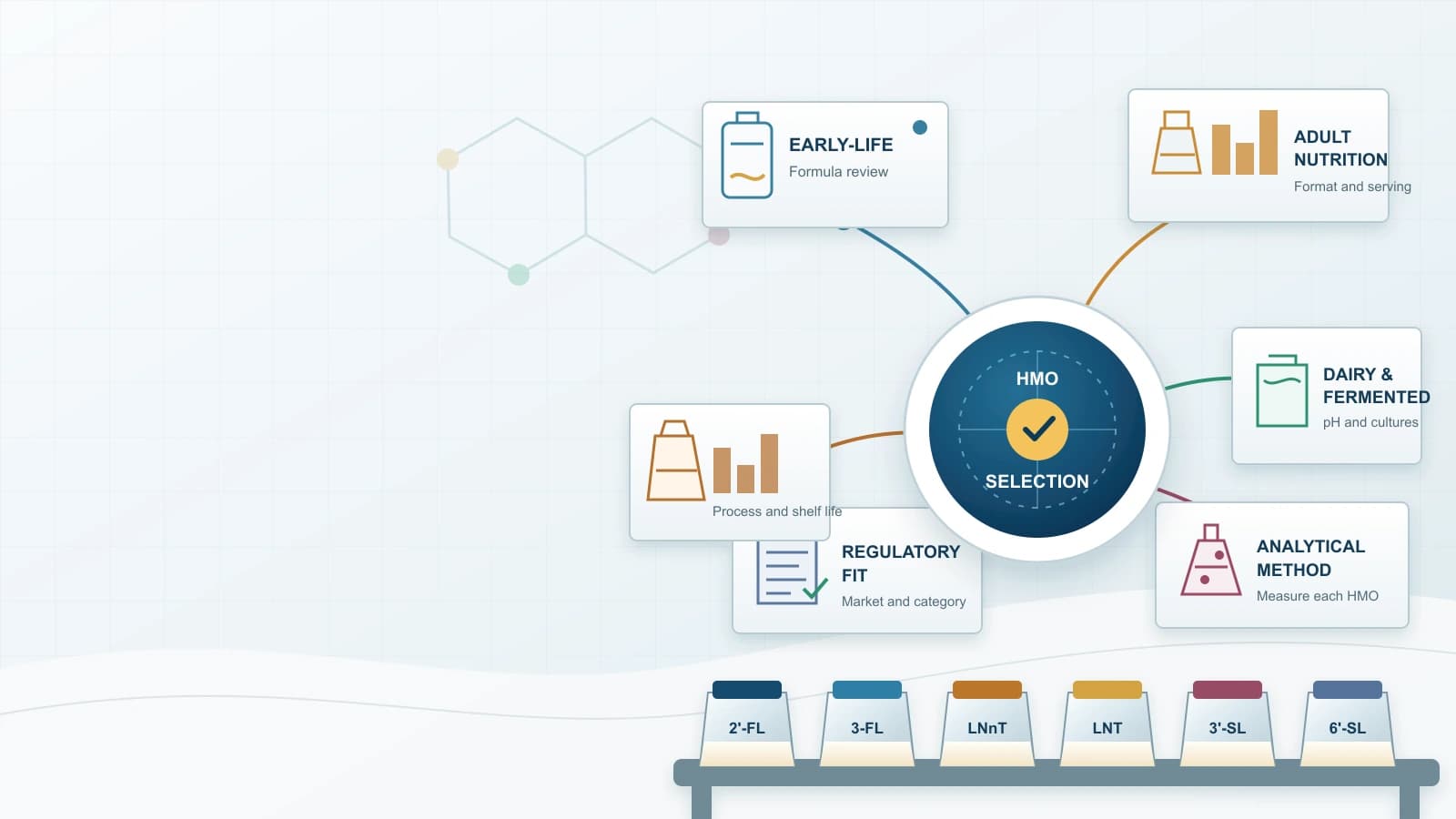
As a formulation developer at a nutrition company, you may receive a request to add an HMO before the team has chosen the ingredient. A list of HMO names cannot make that decision. Start with the finished product, the people who will consume it, and where your company plans to sell it.
I usually narrow an HMO project in this order: define the product, identify the evidence the team wants to use, check the current market requirements, remove options that do not fit the manufacturing process, and compare the remaining candidates in a formulation trial.
Our portfolio includes 2'-FL, 3-FL, LNnT, LNT, 3'-SL Sodium Salt, and 6'-SL Sodium Salt. This article does not compare their specifications line by line. If your team already knows the target HMO and wants to compare purity, related carbohydrates, and release limits, use our six-HMO specification comparison.
The first question is not “Which HMO has the highest purity?” It is “What product are we developing, for whom, and in which market?”
Build the Product Brief
Answer Seven Questions Before Requesting HMO Samples
These questions reduce a broad product list to the options that deserve a real formulation trial:
- Who will consume the finished product: infants, young children, healthy adults, older adults, or people using a specialized nutrition product?
- What is the exact product category: infant formula, follow-on formula, supplement, conventional food, oral nutrition product, enteral formula, or food for a special medical purpose?
- Where does your company plan to sell the product, and does the exact HMO production source fit that use?
- What does the formulation team want the HMO to contribute to the product concept?
- Which human study or other evidence will support the ingredient choice and any intended product claim?
- What heat, pH, moisture, fermentation, mixing, packaging, and storage conditions will the HMO face?
- Can the laboratory measure the selected HMO at the intended amount in the complete finished product?
If the team cannot answer all seven questions yet, start with the consumer group, finished-product format, and market. Those three answers usually remove more unsuitable options than a purity table or a general list of HMO functions.
Start with the Finished Product
How the Product Scenario Changes the HMO Decision
The same HMO name can appear in infant, child, adult, and specialized nutrition discussions. That does not mean the amount, evidence, market conditions, or processing plan can move unchanged from one product to another.
Infant Formula and Follow-on Formula
Ask first: Does the project call for one HMO or an exact combination already used in relevant infant research?
How I would narrow it: 2'-FL often enters the first discussion because infant-formula studies and multiple market records are available for defined sources and uses. A project may instead follow a researched 2'-FL plus LNnT formula or a named multi-HMO formula. Write down every HMO name and amount rather than asking only for a two-HMO or five-HMO blend.
What the team must confirm: Confirm the infant age, formula category, complete daily intake, source-specific market record, microbiology, nutrient composition, amount after processing, and amount at the end of shelf life.
Young-Child and Adult Nutrition
Ask first: Which consumer group and serving pattern does the product use, and what evidence comes from that same group?
How I would narrow it: Do not carry an infant-formula amount into a children's drink or adult supplement. Published adult studies have tested 2'-FL and LNnT alone and together, but the tested daily amounts, duration, and participants remain part of the evidence. Select another HMO only when the product team has a clear reason and suitable support for it.
What the team must confirm: Review the exact food or supplement category, serving size, servings per day, total daily amount, tolerance, claims, flavor, package capacity, and stability.
Oral, Enteral, and Medical Nutrition
Ask first: Is the product an ordinary nutrition product or a specialized formula for a defined group of people?
How I would narrow it: Start with the product classification, age group, nutritional purpose, whether people will drink it or receive it through enteral feeding, and the daily feeding volume. An HMO used in an ordinary supplement may not fit an enteral formula, and infant research does not answer an adult medical-nutrition question.
What the team must confirm: Check the complete formula, daily exposure, interaction with other ingredients, whether the laboratory can measure the HMO accurately, label requirements, and the limits of any product claim.
Dairy and Fermented Products
Ask first: Will the HMO enter before or after pasteurization, UHT treatment, fermentation, or culture addition?
How I would narrow it: First confirm which HMO source can be used in the dairy category. Then narrow the candidates with the real process. Milk, yogurt, and fermented drinks differ in pH, cultures, heat exposure, and storage, so a result from one product cannot predict every dairy product.
What the team must confirm: Measure the HMO before processing, after processing, and at the end of shelf life. Record the heat step, fermentation time, culture, pH, cold-chain conditions, and sensory result.
Drinks, Bars, Gummies, and Powders
Ask first: How much HMO must fit into one realistic serving, and what process will the product use?
How I would narrow it: Remove any option that does not fit the product category or your market. Compare the remaining candidates by supporting evidence, powder addition, taste, acidity, heat, moisture, package barrier, and the laboratory method.
What the team must confirm: Check mixing uniformity, serving accuracy, thermal load, pH, water activity, package protection, measured HMO amount, and physical and sensory stability.
Keep the Study in Context
Choose Evidence That Matches the Intended Product
A study becomes useful for product selection only when the formulation team can explain how it relates to the planned product. Record these details before using a study to support an HMO choice:
- The exact HMO name or named combination
- The production source when the study or market record identifies one
- The consumer group and age range
- The finished-product format
- The tested amount with its unit, such as g/L, g/day, or mg per serving
- The study duration and the outcomes that researchers actually measured
For example, a study in healthy term infants tested 2'-FL and LNnT in infant formula and reported the amounts in g/L. A study in healthy adults tested the same two HMO names alone and together, but used daily amounts in g/day for two weeks. The ingredients overlap, but the consumer group, product use, units, and study duration differ.
A study amount tells you what researchers tested. It does not automatically become the recommended amount for a commercial product. Use the study to understand the tested formula, then confirm the amount that fits the intended product and current market requirements.
Keep the First Formula Focused
Decide Whether One HMO Can Answer the Product Brief
Do not choose a blend only because a longer ingredient list looks more complete. Every added HMO changes the powder calculation, raw-material cost, weighing, market review, specification control, laboratory testing, and label.
Start with One HMO
A single HMO may suit a first product when one ingredient matches the evidence, product category, process, and commercial objective. It also gives the laboratory one target to measure.
Use a Named Blend for a Reason
Choose a blend when the product brief and supporting evidence require the named combination. State every HMO and amount; “two-HMO” or “five-HMO” does not describe a formula.
Do Not Assume a Standard Six-HMO Ratio
I have not found a human study that sets one standard ratio for the exact combination of all six HMOs in our portfolio. A nutrition company must develop and test its own complete formula.
For published blend examples, powder-weight calculations, premixing, and finished-product testing, read our single-HMO and HMO-blend formulation article.
Check the Exact Source and Use
Confirm the Market Requirements Before Choosing the Sample
Two ingredients with the same short HMO name may come from different production sources and may not have the same market records. Confirm the exact source, specification, product category, age group, amount, and labeling conditions before the team fixes the formula.
In the United States, the FDA GRAS Notice Inventory lets a nutrition company review the company that submitted the notice, production source, intended food categories, and proposed levels. A U.S. supplement also needs a separate dietary-ingredient assessment; FDA explains the New Dietary Ingredient notification requirements.
European Union entries also connect an authorized HMO with a defined source, specification, food categories, maximum levels, and labeling conditions. Our U.S. and EU HMO use-level and regulatory article links to exact records for all six HMO types.
Move from Paper to Product
Compare the Shortlisted HMOs in a Formulation Trial
Once two or three candidates pass the product, evidence, and market checks, let the real formula make the next decision. A bench trial should show whether the HMO can be added accurately, survive the process, remain measurable, and fit the product's taste, package, shelf life, and target cost.
- Select no more than two or three HMO candidates for the first bench trial.
- Review the current specification and batch COA before calculating the powder addition.
- Prepare the trial in the actual finished-product matrix, not only in water.
- Measure the selected HMO before processing and immediately after the main heat, fermentation, or drying step.
- Repeat the measurement during shelf life in the intended package and storage condition.
- Compare technical results, sensory performance, cost per serving, and supply requirements before choosing the commercial formula.
Compare cost per finished serving, not only price per kilogram of HMO powder. Batch assay, addition amount, process loss, testing, and the number of HMOs in the formula all affect the commercial result.
Make the Final Decision
Use Six Pass-or-Fail Checks Before Approving the HMO
I would not choose the commercial HMO until the product team can answer yes to all six questions:
| Check | Question the Product Team Must Answer |
|---|---|
| Product Fit | Does the HMO make sense for the consumer, product category, serving format, and product objective? |
| Evidence Fit | Does the supporting evidence use the same HMO, a relevant consumer group, and a comparable product format? |
| Market Fit | Does the current official record cover the exact HMO source, food or supplement category, age group, and intended amount? |
| Process Fit | Does enough HMO remain after the real heat, pH, fermentation, moisture, packaging, and storage conditions? |
| Measurement Fit | Can the laboratory separate and measure the HMO accurately in the complete finished product? |
| Commercial Fit | Can the nutrition company manage the powder addition, cost per serving, supply volume, packaging, and release testing? |
Information We Need before Recommending a Sample
- Finished-product category and intended use
- Consumer age group and expected daily intake
- Country or region where your company plans to sell the product
- Powder, liquid, dairy, gummy, bar, capsule, oral nutrition, or enteral format
- Single HMO, HMO blend, or an open request for a recommendation
- Target amount per serving and expected servings per day
- Process temperature, hold time, pH, moisture, packaging, and shelf life
- Sample quantity, test requirements, launch date, and expected commercial volume
We manufacture six fermentation-derived HMOs. Tell us what you are developing, who will consume it, where you plan to sell it, and how your team will process it. We can then recommend which HMO candidates deserve the first formulation trial.